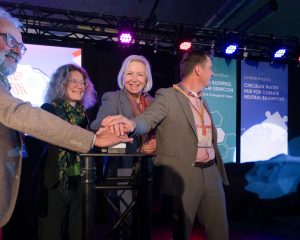
Media: Power duo puts all their effort into Eindhoven Engine

Transforming mindsets in order to empower people and organizations to embrace radical innovation and create a more sustainable world and more humane societies: this is what transformation means at Eindhoven Engine.
The Eindhoven Engine Academy supports this transformation towards innovations regarding the process of innovation itself. It does this in various ways, with its main task being to support the projects and activities of Eindhoven Engine.
Not a traditional academy
The Academy should not be understood as a traditional academy offering seminars and courses to either enrolled participants or the wider public. The Academy is an accelerator, a challenger and a connector of the projects hosted by the Eindhoven Engine. It starts from the challenge at hand, not from the solution. The task (and the desired impact) is the unit of analysis, not the problem-solution itself. This contributes to the richest possible understanding of how solutions might appear. The Academy wants to create and support a learning community in Eindhoven Engine which facilitates innovation acceleration and technology being brought to market. The Academy’s crucial focus is on business model innovation and not so much on technological innovation nor on creating start-ups. It supports technology which is purposeful and impactful (e.g. supports the SDGs or improves quality of life for people).
In the context described above, we work within an innovation ecosystem (Eindhoven Engine) in order to innovate the manner of innovation itself, with a focus on agility and acceleration. The Academy bases its interventions on the following concepts:
- Open innovation
- Co-creation
- Co-location (with virtual extension)
- Activation of the ecosystem’s collective intelligence
- Design thinking and agile innovation
- Systems thinking
- Dealing meaningfully with wicked problems

The Eindhoven Engine Academy supports the projects in the ecosystem and could play a wider role in the Brainport region. It has no ambition to become an institute independent of Eindhoven Engine. Indeed, the Academy can be considered the engine room of Eindhoven Engine.
Failure is the price of innovation
“You have to accept failure. If every project from your innovation department is a success, you are not bold enough in your endeavor to innovate. You are minimizing risks and playing it safe. Failure is inherent to innovation.”
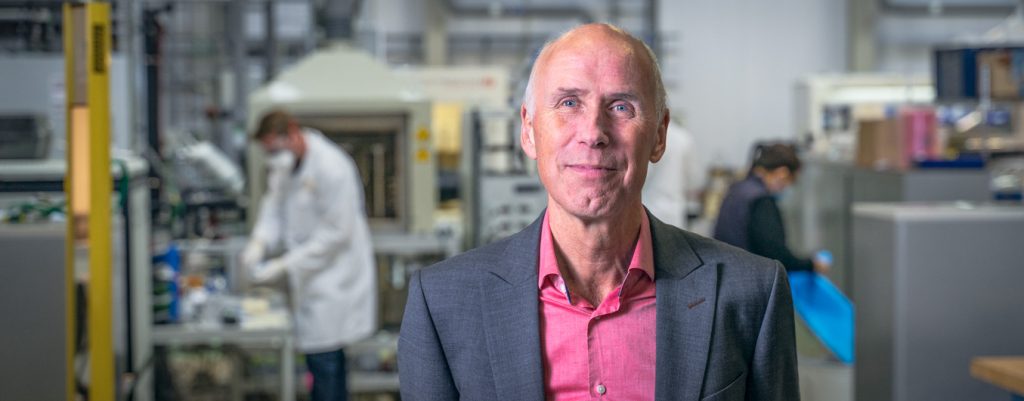
We are sitting in a conference room on the High Tech Campus in Eindhoven and speaking with Jaap Lombaers, Director Knowledge Management and Partnerships at TNO. The room is situated in a modern, open-spaced building with large windows everywhere. Behind Jaap, there is a view into the laboratory. Researchers in white coats and safety goggles walk calmly and decisively from machine to machine under a maze of pipes reflecting the bright ceiling lights.
Applying new science and finding a market
A background in industrial design is not overly common for those working in a laboratory but when I mention this to Jaap, his eyes light up and he smiles. “I am inspired by all the things that go on inside this lab. I can tell the story of every machine in this room and why it is important to the progress of solar energy and of innovations in electronics. This lab is the merger of science and application.
You are right, industrial design is integrative rather than specialistic; during my studies, I learned to combine different fields of science and apply them to find new solutions. And this is what we do every day here at TNO.
What we try to accomplish at TNO isn’t just about science. The primary goal is working with large, multidisciplinary teams to create functional and economically-viable solutions. It’s a team effort in which we combine fundamental and applied science in order to create innovative solutions for the market.”
Combining strengths and creating a boost
“TNO is always on the lookout for partners who can amplify the abilities of our own organization. This is one of the reasons we supported the Eindhoven Engine initiative and even became a shareholder.
We appreciate that our partners, TU/e and Fontys, really are different from us and therefore complementary. Where we are trying to apply science, universities are pushing the frontiers of science itself and developing the new talents that industry and research organizations need.
These are bottom-up organizations with students, PhDs and scientists who are conducting new research. This creates a reservoir of young, keen minds which can provide a fresh, new perspective in ongoing projects. TU/e and Fontys are also connected to a vast network of companies, especially in the region of Eindhoven. Just like TNO, they frequently cooperate with large and well-known companies as well as smaller ones which do not have the luxury of extensive R&D departments.
In Eindhoven Engine, we combine these assets. We create multidisciplinary teams of research partners and students, unite them in one location in order to increase collaboration and give ongoing innovation projects a boost.
“If you want to make a leap
in your innovation project in just a couple of years,
Eindhoven Engine is the perfect platform.”
Not every innovation project is suited to Eindhoven Engine. If you want to do in-depth research, you just give scientists a large amount of time and resources to get to the bottom of it. But if you want to make a leap in your innovation project in just a couple of years, Eindhoven Engine is the perfect platform. At the moment, we have a team working on the development of a heat battery, for instance. This is an established program to which Eindhoven Engine adds an extra layer to accelerate the progress. In another project, we are developing solutions for flexible manufacturing (smartly combining the skills of operators with those of robots) alongside Fontys and multiple companies in a field lab on the Brainport Industries Campus (BIC).”
We just started
This kind of coordinated, multidisciplinary and systematic way of doing research is built into the genes of TNO. “We have gained considerable experience over the years in cooperating with different partners and consortia. This experience is what we can add to Eindhoven Engine. But don’t forget, Eindhoven Engine just got started last year. The paint had just dried in the Eindhoven Engine building when the corona pandemic engulfed the world. So, we have to give it some time to see what works well and what has to be improved.
There are still things we have to figure out. How to make smart use of co-location? I would recommend that the teams be situated at the best location given the nature of their projects. I would say that a team working on solar panels, for instance, should situate itself here at Solliance. In this building, we have a whole laboratory equipped to do research on thin-film solar cells. For those teams not permanently located at the Eindhoven Engine co-location, this location could be used as a clubhouse of sorts: a place to visit regularly and where cross-pollination between the different teams involving multiple organizations can occur. I am convinced that we can learn a lot from each other.”
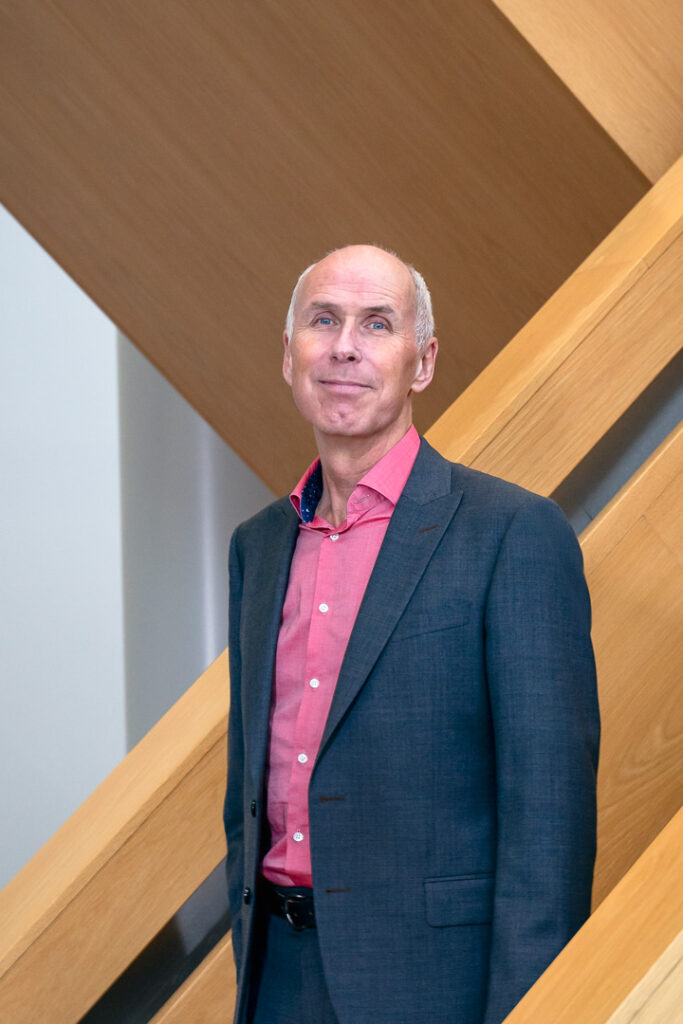
As the site of Eindhoven Engine’s co-location, MMP (previously MultiMediaPaviljoen) plays a key role in Kadans Science Partner’s mission of creating and supporting innovation ecosystems. Kadans Commercial Manager Pim van Os and Eindhoven Engine Managing Director Katja Pahnke discuss how recent renovations help realize this vision.
A mix of old and new
MMP, a multi-tenant office used mainly by TU Eindhoven initiatives, was purchased by Kadans in 2019. Plans for renovation began immediately, as Pim explains.
“It was an old building without the right structure for users – it was actually a bit like a student house! There are three aspects for us: you need to inspire tenants and guests, you need to connect different functions and you need social interaction. Innovation often comes from unexpected corners, like the coffee machine. This is how we approached our renovation plan.”
Kadans aims to stimulate maximum usage of shared areas, increasing the chances of collaboration.’ – Pim
The result is a mix of old and new, bringing together aspects of the building’s former industrial nature with updated elements like flooring and furniture. Kadans aims to stimulate maximum usage of shared areas, increasing the chances of collaboration but also generating a friendly atmosphere in which people look forward to their work. “We didn’t do this alone,” Pim notes. “We did it in good consultation with one of our partners: Eindhoven Engine.”
Eindhoven Engine’s ambition is to boost innovation in ‘unprecedented’ ways, deal with societal challenges and create a unique synergy between (bachelor’s, master’s and PDEng) students, scientists and companies while working on multidisciplinary projects.
In order to facilitate meetings between students, scientists and innovators of industry, we now have a vacancy page for students looking for ground-breaking, impactful assignments in one of Eindhoven Engine’s projects. Projects are invited to post their assignments. Bachelor’s, master’s, PDEng and PhD students who are interested are invited to have a look!
Eindhoven Engine student vacancies website goes live!
In the Eindhoven Engine project SmartTwo+, KPN and TU Eindhoven collaborate on maverick telecom technologies for the societal challenges of mobility, safety and smart cities. This is where Nico Baken feels at home: as a professor in TU/e’s Electro-Optical Communication group, he’s also spent almost 40 years carrying out fiber-optic research for KPN. In this article, he discusses what Eindhoven Engine’s multidisciplinary approach means to the project.
The need to build bridges
“KPN formally had a lab of their own. In the sixties, there were over 600 people,” begins Nico. “KPN had the UMTS [Universal Mobile Telecommunications System] auctions in July 2000 and discovered in late autumn that they had made a huge mistake and were bankrupt. On 1 January, they sold the laboratory to TNO for one euro. That had quite some consequences. First, we didn’t get an influx of new people from the lab to the operational organization. Second, the connections with the universities were much less strong – there were only a few people left who could even communicate with them.”
This difficult situation led to the formation of Flagship Telecom in 2017, a partnership between KPN and TU/e on areas like software, data analytics and AI. This actively seeks out collaboration and was also the origin of predecessor project SmartOne. “I’m trying to build bridges between KPN and the university, but also inter-faculty,” Nico explains. “One of the points of the Engine is that you get interdisciplinary connections – whether these are between sectors, faculties or companies. Maarten Steinbuch believes in this.”
Mr. Smart City
Another key alignment is Eindhoven Engine’s focus on accelerating the technology-readiness levels of potential applications. “It would be nice to have senior researchers from TU/e in combination with senior people from companies,” continues Nico, “and I hope that the PhDs will be able to make the whole more than the sum of the parts. A lot of contact is needed for that. That’s why it’s good that you have room where all these PhDs come together.
“One of the points of the Engine is that you get interdisciplinary connections.”
In the ongoing pandemic, Eindhoven Engine’s trademark co-location has often had to move to the virtual world, but Nico sees a positive side to this: “KPN could have done any advertisement campaign for Zoom but it wouldn’t have worked as well as corona. That’s a big change. When it’s over, many more people will work from home.”
Alongside ad hoc meetings, the project members hold KPN-organized plenary meetings each quarter and an annual general meeting which includes TU Delft. Regular contact within the project is vital as it provides greater empathy for different perspectives, as seen in disagreements on the smart city element. Nico: “The students regarded me as Mr. Smart City but the first question I asked is do we really want to live in cities? They didn’t like that! The tipping point is 2060, when the world population will decline. We still have some 40 years to think about how we truly want to live.”
Breaking out of silos
A final ingredient is challenge-based learning, in which knowledge is gained by tackling real-world issues. One of the project’s two PDEngs, for instance, is titled Traffic flow modeling and control in a smart city environment and has led to a spin-off mobility project with Utrecht municipality. As the SmartTwo+ network continues to grow, Nico sees opportunities to further revolutionize its methods of collaboration.
“I hope to give the participants more than content: awareness of the integral systemic impact they can have. Of course, the technological developments will need to contribute to sustainability and comfort for all people. But the difficulty at KPN is finding people who have a passion for being a coach to PhDs and PDEngs. You need continuity, so why not reverse the formula? Money and coaches are now coming to the university from KPN, but we could also get some professors for half a year. That’s really forming bridges. If humankind doesn’t make it, it will be because we stayed in silos.”
LinkedIn is the most commonly used digital network for professionals. It is therefore excellent for sharing knowledge such as publications, white papers, presentations and meetings.
This summer, the Eindhoven Engine office team invested time into a LinkedIn networking training directed by social media guru Daria Tataj. Each team member has adjusted his or her profile based on Daria’s tips. What followed was the identification of everyone’s network. Which networks could be relevant to Eindhoven Engine? And who is the largest influencer within each network? What characterizes that influencer? If that influencer is relevant to Eindhoven Engine, how can we make them enthusiastic about the Eindhoven Engine formula? And which hashtags are important? As a result, our total number of followers has increased from approx. 500 to over 1800 within a few months. We hope that you’ve enjoyed reading our posts and learned more about our vision and our activities.
If you want to know more, simply follow Eindhoven Engine on LinkedIn. Welcome to our community.

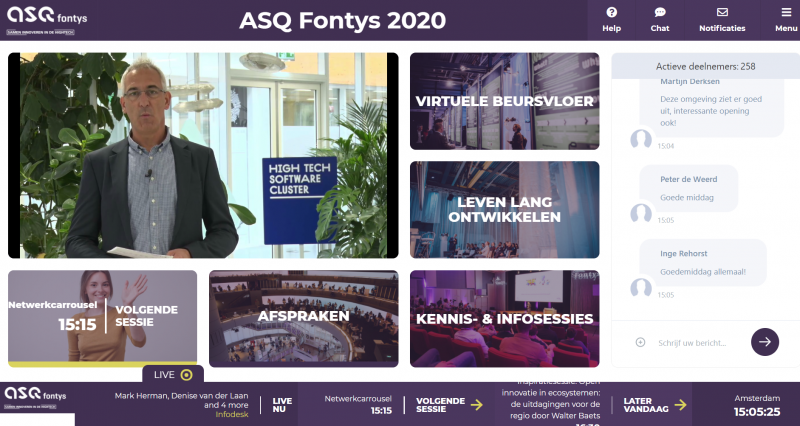
Every year, Fontys University of Applied Sciences brings together the (high-tech) business community with experts from its own ranks in order to encourage mutual cooperation. This takes place under the name ‘ASQ Fontys’ and is organized by the Fontys Centre of Expertise HTSM (High Tech Systems and Materials). ASQ stands for All Sorts of Questions. The 2020 edition took place on 3 November and was completely virtual. This worked out well for the organization and for the 300+ visitors, who seized the opportunity to be inspired in a wide range of technical fields.
The fourth edition of ASQ Fontys offered a diverse range of options: 13 interactive knowledge sessions on research took place simultaneously in various online spaces in addition to seven information sessions on education for professionals.On the virtual exhibition floor, 38 stands were set up through which researchers and students spoke to visitors about their HTSM research projects. One of the knowledge sessions was dedicated to the Eindhoven Engine formula.
Walter Baets: “We are trapped in a linear and causal way of thinking. If we do what we have always done, we get what we always got. We cannot innovate, we re-search. Design thinking is needed.”
Walter Baets concluded the afternoon with a keynote lecture on open innovation in ecosystems. “Our challenge is business model innovation. The energy of imagination will start where time and space are one; that’s part of the Eindhoven Engine formula. Your personal transformation journey starts here.”
Networking
“A major challenge for this online event was the networking component,” says Mark Herman, who organizes ASQ Fontys on behalf of the Centre of Expertise HTSM. “We know that our visitors, including many technical SMEs from the Brainport region, come mainly to discuss innovation issues with each other and with experts and students from Fontys. At ASQ, we offer a platform where encounters are possible and where we do our best to make those encounters as inspiring and easy as possible. To this end, we organized knowledge sessions and a network carousel. But we were a bit uncertain on whether there would be sufficient interaction in this digital setting. The reactions of the participants, plus the fact that more than 100 appointments were made, gave us the confidence that we had succeeded.”
Innovation
At ASQ Fontys, high-tech entrepreneurs can turn to each other and to experts from Fontys with all of their questions. These questions can lead to research in which companies, Fontys researchers and students take on a challenge together. This is already happening: 38 research projects were presented on the virtual exhibition floor, showing that cooperation can lead to innovative solutions. This is not only relevant for the company involved but also provides topical and context-rich education for Fontys students.
Corona research
The latest batch of research revolves around a current theme: corona. Researchers are investigating how high-tech can contribute to recovery and innovative strength during and after the corona crisis. Cees van Tilborg is leading one of these projects, ‘A robot is not a super spreader’. “In the hospitality industry, we see a lot of problems with the serving of food and drinks. People infect each other. The idea is that a robot can offer a solution because it spreads fewer viruses. The main goal of our research is to create a robot that can help in the hospitality industry and canteens, and later in the healthcare sector, and which is affordable.”
Read more about all HTSM research projects at www.fontys.nl/htsmonderzoek (in Dutch).

On Thursday 12 November, the fourth Impactful Innovation webinar for our internal community took place hosted by Judith Tesser and co-hosted by Joris Dufils. The goal of the webinar was to actively work towards cross-project group interactions not only by sharing challenges and innovations but also by continuing to challenge ourselves in order to generate more impact with our projects.
PerStim & IntelLight+ Projects

Rob Mestrom and Steven Beumer (PerStim) and Harold Weffers (IntelLight+) shared their stories of how they are working on meaningful, impactful innovations. In the PerStim project, which stands for Personalized Neurostimulation, Rob, Steven and their team are investigating how treatments for individuals with specific forms of epilepsy can be personalized effectively using a non-invasive approach in order to improve quality of life for these patients. Light plays an important role when looking at quality of life, as we learned from the second talk by Harold, coordinator of the IntelLight+ project. Harold explained how human-centric lighting could benefit us all through the development of algorithms for inferring and even predicting user context in order to accommodate user needs and preferences. Other aspects include innovative lighting and new design methodologies.
Through the sharing of knowledge during these webinars, we are seeing the first unexpected crossovers arise – the key to unleashing our collective intelligence! Thanks to our speakers, Rob, Steven and Harold!
Technology is developing at an exponential rate.
The impact is already felt in many domains of our daily lives: Our cars have become iPads on wheels and will partly become autonomous robots. We are addicted to the information flow of our smartphones. Our homes are becoming “smart,” and we watch TV via the Internet.
Corona accelerated the adoption of remote work and online meetings by at least two years. The pandemic also sped up the digitalization of healthcare.
How can researchers, innovators, founders, investors and entrepreneurs best use our collective intelligence to focus on future challenges? How can we create innovative processes and explore all the possibilities?
The question becomes, “Are we fast enough? Can we scale fast enough?”
Innovation by trial and error
One limiting factor is that knowledge generation and dissemination are normally followed by industrialization via existing companies or by founding startups. If we really want to speed up, the least we should do is practice concurrent innovation.
An even bolder move would be innovation through trial and error, through iteration loops and through learning by doing. And, of course, we need to devote more resources to innovation, including capital and talent.
In fact, if we co-innovate by bringing together people from research and from industry, we will accelerate all innovation processes, balancing between creative disruption divergence and focus.
This is what we want to achieve with Eindhoven Engine and this is also why I am on the Board at LUMO Labs.
Collective intelligence
It’s crucial to motivate researchers and executives to unite in our efforts to accelerate innovation.
In the university research space, our corporate partners make sure we have the resources to understand, then solve, real-world problems. At the same time, this collaboration allows us the freedom to look far into the future, anticipate what’s coming next, then leverage these insights.
This stimulates researchers to invent new solutions in the form of new theories and new designs. Combining new ideas with young entrepreneurs as well as experienced people into startups or new business for existing companies leads naturally to new implementations in society.
Cross-domain information exchange is crucial to co-creation. We call this “enabling” or “unleashing” our collective intelligence. It is obvious to implement in established ecosystems such as Brainport. And digital networking will also help build and sustain a global network of innovators dedicated to exponential innovation.
We are living in a very interesting time, when new technologies emerge so quickly, and societal challenges are so compelling.
We see the potential, and we should do our utmost to increase the speed of innovation. Connecting people and using our networks are the key ingredients for success. In the end, it is all about people and unleashing their full potential.
Prof.dr. Maarten Steinbuch
Scientific Director Eindhoven Engine
Member Advisory Board LUMO Labs