The gap between fundamental research and industry
First section of a two-part interview. Read here the second section.
“Eindhoven Engine is based on an essential need in the research and technology landscape. I worked thirteen years at TNO, of which I was chairman of the board for six. As such, I came to the conclusion that TNO is a crucial research organization in the Netherlands. In 1932, TNO was founded to take theoretical discoveries from universities and turn them into applied technical solutions for society and industry.
“There is a missing link in the technology development scale from brilliant research idea to market introduction. From proof of principle through to proof of concept and from a science prototype to a developed prototype ready for production for the market.
“Institutes of applied research, like TNO, can bridge that gap and complete the full chain of technology maturation. The relationship with the universities and the transfer of knowledge is essential in this case. If that process of knowledge transfer (in which TNO can play a key role) had been better developed, Eindhoven Engine would have never seen the light of day.”
“Eindhoven Engine is based on an essential need in the research and technology landscape.”
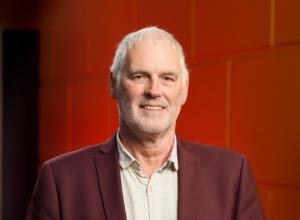
It’s early spring. At the time of this interview, the wind is picking up, gray clouds race overhead and it’s starting to drizzle. This didn’t stop Jan Mengelers – a member of the Eindhoven Engine board until 1 March 2021 – from showing up. A few minutes earlier, he passed the rectangular pond and strode across the grand square surrounded by the towering glass buildings of Eindhoven University of Technology. Very familiar surroundings for him because he was president of this university until mid-2019.
We settled ourselves at the bright yellow picnic tables under the canopy of the main building. “I think this job was actually the job in my career I did best,” he says with a sigh and a slight grin while pointing at the entrance behind me. “This position was the crown of my career. I was finally able to combine all the experiences of previous jobs and put them to good use with more wisdom in this job.”
Obtaining finesse
“When I was thirtyish, fortyish, I was quite different, very eager to achieve ambitious goals with a lot of drive and hard work. I recognize this now in younger generations of the same age. Just like them, I was all ‘sturm und drang’. I missed finesse, diplomacy and thoughtfulness. The older I got, the more it became clear to me that my style had to change. You learn to be more patient, with more understanding of the context of things, and to respect different opinions. Achieving a compromise is not a failure but rather showing respect to the other stakeholders in the process.”
Three worlds co-existing
“We digress; your question was why Eindhoven Engine exists. In the past, the overlap in research between universities, institutes like TNO and industry was greater. Philips NatLab, for instance, did equally good fundamental research as most universities. The transfer of knowledge into marketable solutions was organized in the company itself. But as industry reduced their funds for fundamental research, departments like NatLab reduced substantially and became extremely focused. On paper, institutes like TNO could fill this void. Of course, the researchers of the university and TNO are acquainted with each other, but there is too little symbiotic merging in cooperation.
“In reaction to the 1996 policy of minister Maria van der Hoeven, universities had to also deliver valorization of their knowledge in addition to excellent education and outstanding research. Universities therefore started organizing Technology Transfer Offices. In order to prove the worth of their research, they tried to apply it in practical solutions. This way, the activities of the universities showed an overlap with institutes like TNO. Across universities, a new type of business development was created to bring technologies from curiosity-driven research to application-driven solutions. They started creating and maintaining patents and establishing start-ups. Nevertheless, the universities found it hard to create a smooth transition for technologies. The universities realized that it is not in their nature to build applications. They excel at creating fundamental research and sharing their knowledge in publications, but not in tinkering with a prototype and reproducing it over 35 times until perfection for market introduction. “Three worlds started to exist next to each other: universities, industry and institutes like TNO.”
In need of a NatLab 2.0
“As industry reduced their budgets for fundamental research, they recognized that the brainiacs at the universities produce the most ingenious solutions. The trouble was that these ideas stayed at the universities. There was too little effort to develop them further in order to bring them to the market. I think it would have been best to rearrange the whole research and technology landscape of the Netherlands just to optimize the route of new technologies to the market. It is possible, but you will probably need a good crisis. The solution-driven cooperation between scientists and manufacturers in the recent worldwide COVID-19 crisis is proof of that. “As long as there are higher stakes, no real crises and money to earn with existing proven processes, nothing will change drastically.
“The Engine closes the gap between fundamental research and the market by creating teams of scientists out of the three worlds.”
“We therefore came to the conclusion that we need a NatLab 2.0 embedded in the industrial ecosystem of Brainport. An organization that picks up promising and inspiring fundamental research at the universities and turns it to meaningful solutions that society can benefit from in everyday life. Together with Maarten Steinbuch, we started making plans and we came up with Eindhoven Engine.
“The Engine closes the gap between fundamental research and the market by creating teams of scientists out of the three worlds (universities, industry and institutes) and letting them work on innovations with inspiring ‘moonshot’ goals, preferably co-located in one building. I think that we have successfully created a concept which mends the flow in the progress of technology maturity levels so that it can be a fluid continuum again.”
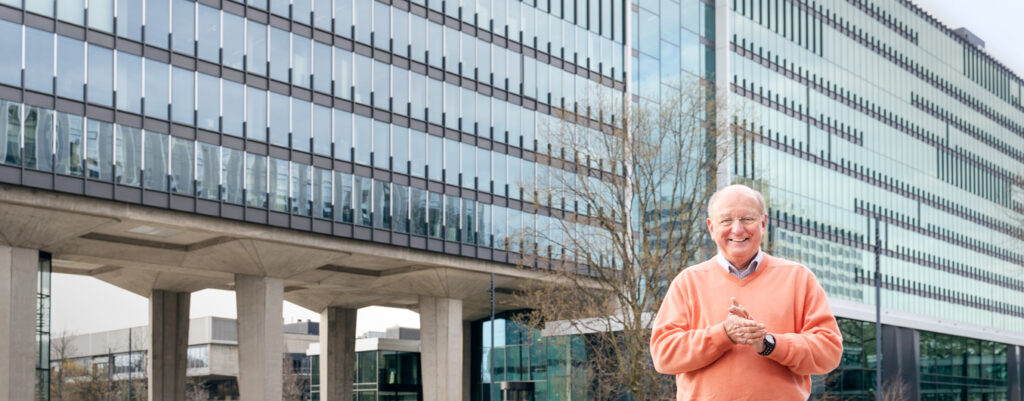
At the height of the corona pandemic, we used no less than 4.2 million disposable isolation gowns per week in the Netherlands. During a ‘normal’ week in healthcare, an average of 770,000 isolation gowns end up in the trash after one use.
During the first lockdown, the great dependence on production from East Asia soon became clear, especially when it comes to protective clothing for healthcare. With a great shortage of masks, gloves and isolation gowns, among other things, the national consortium had to search for the right materials. Not an easy task, because the origin and degree of protection of many protective materials was unclear.
In order to be better prepared for crisis situations in the future, it is important to tackle this problem at its core: a long-term solution so that we will not be surprised again.
With the strong sustainability ambitions that our government has set for 2030, an economic and circular solution is needed. In order to not miss out again, security of supply and production closer to home is the goal.
Fast innovation through collaboration
Fast innovation and joining the right forces have therefore been the starting points for Eindhoven Engine, TNO, Eindhoven University of Technology and HAVEP in taking up the challenge of developing economically and circularly sustainable medical isolation gowns. In this so-called Triple Helix collaboration, the business community, government and education and research institutions join forces to innovate quickly. The strength of this successful collaboration lies in the openness and transparency between the parties and the short communication lines that they have with each other. The parties also work side by side and constantly learn from each other, which makes them equal in this collaboration. Bringing together the market, researchers and a concrete demand from healthcare and government provides a realistic picture of what the end result should look like. In this case: a sustainable isolation gown for healthcare which can be worn at least 50 times and recycled after its end-of-life.
Entering the second phase
The parties involved have now successfully completed the first phase of their innovative collaboration on behalf of the government and the report of the feasibility study has been submitted. At the beginning of June, it will be announced which parties are allowed to continue their research in phase two of this government tender based on the SBIR (Small Business Innovation Research) scheme. In this second phase, the feasibility of the product will be further tested and various cases will be trialed on the market.
Progress report Regio Deal Brainport Eindhoven
In the third year of Regio Deal Brainport Eindhoven all participating parties, including Eindhoven Engine, have worked on strengthening the business climate, attracting talent and creating innovation in our Brainport region.
In 2020 Eindhoven Engine has accomplised to start with six new OpenCall 2020 projects and having 250 scientists, students and employees linked with Eindhoven Engine, working together in total of 15 innovation projects. In the meantime the co-location on the TU/e campus is renovated and ready to welcome the Eindhoven Engine community to collaborate, connect and get inspired (as soon as the COVID-19 measures allow).
- Read more about the Progress Report Regio Deal Brainport Eindhoven (Dutch)
- Read more about Regio Deal Brianport Eindhoven (Dutch)
On top of what Eindhoven Engine does with its regular projects and the community building around it, we also want to launch projects that are challenge-driven, multidisciplinary and promise to be impactful. Can we use the collective intelligence of students, the founding partners of Eindhoven Engine and the Brainport Region to contribute to the co-creation of solutions for those wicked problems in an open innovation manner? Eindhoven Engine has identified a few potential demo projects and wants to kick off with the ‘Future of Work’.
In a world in which we do not know how half of all jobs will look in ten years’ time, what will the relationship be between work and (lifelong) learning? Is remote work more effective and/or flexible and does it contribute to a better life/work balance? Do the lessons learnt from the corona crisis mean that we should fundamentally rethink what we do and how we do it? Can technology play an interesting and impactful role and what would this look like? Many challenging questions for which we do not have the answers; hence, a real wicked problem.
Business Model Innovation approach
At this stage, Eindhoven Engine Academy wants to prepare the launch of the demo project through a series of four seminars with a limited number of participants from the founding fathers (TU/e, Fontys, TNO), our own team, some volunteers that are active in current projects and a few students. We are going to follow a compressed format of the Business Model Innovation approach mentioned in our previous newsletter, bringing it together in four two-hour sessions and continuous group work in between the sessions. Each session has a theme, after which the groups will work in co-creation on the definition of the project.
The themes covered are: a complex world creating wicked problems; design thinking and systems thinking; complex adaptive systems and collective intelligence; organizing for emergence.
In a month’s time, we will have the context and the briefing for our first demo project: the Future of Work.
The kick-start of a self-running engine
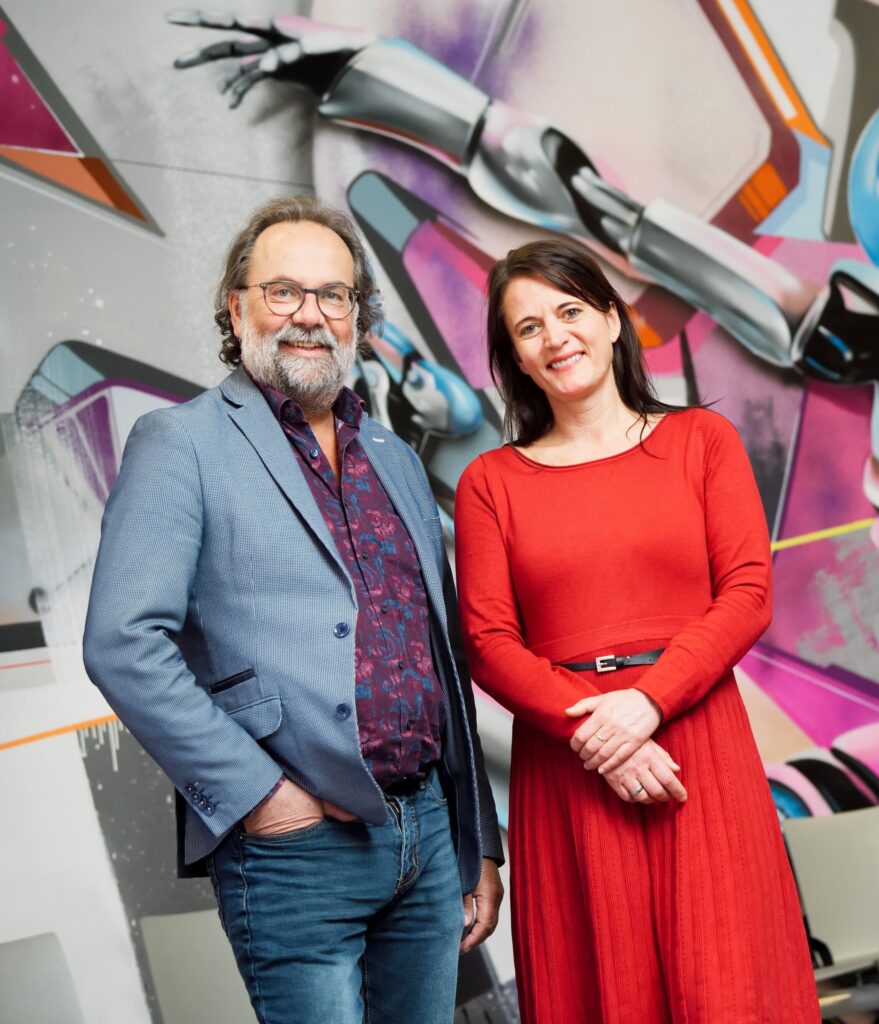
All is well at Eindhoven Engine. It’s been two years since this joint venture of Fontys, TNO and TU/e saw the light, as part of TU/e’s Strategy 2030. The ‘innovation accelerator’ is going strong. Already, more than 150 people and 15 projects are working on exciting innovations accelerated by Eindhoven Engine. And if you ask directors Katja Pahnke and Maarten Steinbuch, there’s much more to come.
“Eindhoven Engine is one of a kind,” says Maarten. “Nowhere else will you find something like it. At Eindhoven Engine, we provide the possibility to work together in new forms of collaboration. We share knowledge, bring people from different backgrounds together and challenge them to look beyond their own discipline and beaten path. Through that we accelerate innovations that can truly change the world. In these first two years of our existence, we are proud to have already worked on 15 projects. It is so inspiring; people are beginning to think differently, act differently and work in new ways. The Engine formula works.”
Co-location, co-creation
Co-location and co-creation are key-words in the way Eindhoven Engine works. The Engine facilitates a perfect environment for creative professionals with the urge to transform their ideas into innovations that offer answers to social issues we face as a society.
It offers researchers and scientists the opportunity to come into contact with like-minded innovators, ambitious students and professionals from industry, each with their own knowledge, expertise and life experiences. Together, they can team up and let the energy flow.
How? Katja: “Once a year, we invite consortia consisting of industry partners, universities and other knowledge institutes to submit project proposals to our OpenCalls. Already, many consortia have found their way to us. Through inspiring network meetings, creative workshops and courses organized by Eindhoven Engine Academy, we give them the opportunity to meet each other.” The results of the current OpenCall 2021 will be published before summer 2021.
“Our ultimate goal,” Katja continues, ” is for an important part of the projects to be carried out at our location in the MultiMediaPaviljoen (MMP) on the TU/e Campus. There, people can really meet each other, work together and co-create. Corona made that difficult, so we did a lot of things online over the last year. That was challenging, but we still managed to keep a lot of very special projects going and intensify the cross-over interactions between the projects. And Corona also has an upside: in times of crisis, the need for innovation acceleration increases. Furthermore, it helps us to ‘rethink’ and adapt faster to this virtual world.”
Diversity in projects
Katja and Maarten are very proud of the projects that are now being carried out within Eindhoven Engine. “Each project has to have something to do with the Brainport Region”, Maarten explains. “That means we don’t do projects in the field of water management, for example. Currently we have projects in the fields of mobility, medical technology, smart cities, vitality at work, health and energy. It’s very diverse.”
A small selection of current projects mentioned by Katja and Maarten illustrate this diversity of Eindhoven Engine: “Together with TNO we are working on reusable isolation gowns and face masks. With that, we can hopefully put a stop to the millions of masks and isolation garments that are thrown away each day. TU/e, Fontys and companies work together on vitality in the workplace under the project name POWEr FITTing: FITTing Persons’ vitality and optimizing their work environment. Carbyon DAC is also involved and works on direct air capture of CO2 from the atmosphere. What’s also very special is JUNO: the development of a prototype for a perinatal life support system, an artificial womb for babies born at 20-24 weeks. The two women involved, are already thinking about how they can bring that artificial womb to the market while they are still in the research & development phase. Talk about acceleration of innovation…”
Into the future
Eindhoven Engine is becoming well-known in this ecosystem. Goals are being reached, people are being connected, and they are working passionately on their projects every day. More and more people are joining Eindhoven Engine and becoming ambassadors, like the recently joined new members of the Advisory Board and Supervisory Board Jan Haagh (TU/e Business Development Manager) and Elke den Ouden (TU/e Fellow).
“People are beginning to think differently, act differently and work in new ways.
The Engine formula works.”
What is there to wish for in the near future? “We are very happy with how it is going,” says Katja. “It gives us so much energy. We are accelerating ourselves; it’s almost like a self-running engine. People that work on projects at Eindhoven Engine, are developing new ways of working. They are stepping into their own future with new skills and greater professionalism. And for TU/e, Eindhoven Engine is a great asset as well, serving as a platform for new collaborations between knowledge partners and companies and for the valorization of research and creation of new collaboration models. Our core values are entrepreneurship and out of the box thinking and our people are open-minded, creative, value-driven and easily accessible. One of the goals of Eindhoven Engine was to connect 500 people to the Engine by 2030. At the pace at which we are now going, we will reach that goal in 2025 already. We are very proud of everyone at Eindhoven Engine and are looking forward to all that is still to come.”
Do you want to stay updated about Eindhoven Engine? Sign up for our newsletter and follow us on Twitter, LinkedIn and Instagram.
Photo is taken before Corona.

My name is Martijn de Kleijn and I am 23 years old. I have been living in beautiful Eindhoven since the day I was born. I am working at Eindhoven Engine because of my fourth-year internship at Fontys. My thesis will be about (brand) awareness of Eindhoven Engine and the process for students who are searching for a thesis internship. So, I will be investigating how and where students from Fontys and TU/e look for internships.
Feel free to contact me if you have any tips regarding these two topics.
Eindhoven Engine
A podcast with Katja Pahnke and Maarten Steinbuch about how Eindhoven Engine accelerates innovation, including two projects. Marieke van Beurden will give you insight about the POWErFITTing project and Gregor van Baars will tell you about the Advanced piezo-electric wafer stage project.
This is part of a serie of podcasts about the Regiodeals in the Netherlands. Eindhoven Engine is part of the Brainport Regiodeal.
Dear Members,
We started this year with some really nice highlights, and we would like to share these with you. Although we are still working remotely, we have put a lot of effort into the Eindhoven Engine OpenCall 2021. On 3 February, we announced that the OpenCall 2021 is open. The opening of our co-location (MMP building) is another highlight. MMP is now ready to welcome our Eindhoven Engine community to collaborate, connect and get inspired! Let’s hope we can do this safely as soon as the COVID-19 measures allow.
In this edition, you can read an interview with Sonja Vos, CEO of TU/e Participations and TU/e shareholder of Eindhoven Engine. With this interview, we have completed our trilogy on sharing the views of Eindhoven Engine’s founders – TU/e, TNO and Fontys – on how to accelerate innovation in Eindhoven Engine and the need for agile innovation. Jaap Lombaers (TNO) and Ella Hueting (Fontys) gave their interviews in previous editions of the newsletter.
Today, the project in focus is SmartMan. Hans Krikhaar (Fontys project leader of SmartMan) and Kees Adriaanse (Fontys Liaison Officer at Eindhoven Engine and program leader of Fontys Centre of Expertise High-Tech Systems & Materials) explain the various aspects of smart manufacturing and collocative work by students on behalf of SMEs during this innovative project.
Also in this edition:
- ‘Isolation gowns’ innovation competition project selected for the RVO SBIR (Small Business Innovation Research)
- Eindhoven Engine project vacancies for students
- ‘Kracht van de Regio’ podcast: Eindhoven Engine as example of a RegioDeal project, discusses the successful formula of projects and their added value
- Eindhoven Engine Academy news: Business Model Innovation in an Exponential World by Walter Baets, Learning Officer Eindhoven Engine Academy
- Eindhoven Engine Community of Practice
- PDEng Design Challenge
Enjoy your read and become part of our community! Stay safe and healthy.
Katja Pahnke and Maarten Steinbuch
On 28 January 2021, the Netherlands Enterprise Agency (RVO) accepted Eindhoven Engine’s Small Business Innovation Research (SBIR) proposal on sustainable medical isolation gowns. Through SBIR, the government is challenging entrepreneurs to come up with innovative products and services to solve societal issues. Together with TNO and HAVEP, Eindhoven Engine submitted a proposal and we are proud to have been selected as one of the five projects. 10 proposals were submitted in total.
The fight against the COVID-19 virus is generating a lot of waste. The vast majority of protective materials used in the healthcare sector need to be destroyed after a single use due to the risk of contamination. In this research, Eindhoven Engine and its partners will focus on the development of sustainable medical isolation gowns that can be used multiple times: the ProH I-gown. In addition, an investigation will take place into how the production capacity can be made (economically) scalable and flexible when necessary.
These sustainable medical isolation gowns can save six tons of CO2 per million gowns. If these isolation gowns are fully utilized during crisis situations, the result could be a saving of 0.2% of the total plastic waste stream in the Netherlands. In addition, ProH Isolation gowns stimulate the production of protective clothing in Europe.
The execution of this research for the healthcare sector in the Netherlands consists of two phases. In this wonderful collaboration between innovation accelerator Eindhoven Engine, research organisation TNO and manufacturer HAVEP, a technical feasibility assessment will be carried out in the first phase. A business case will also be set up. The gowns will be made of woven PET material with an environmentally friendly coating. Research will also be carried out into the durability and wearability of these gowns. HAVEP will contribute its many years of knowledge and experience in the development and production of fabrics to this partnership. For this first phase, EUR 25,000 has been made available. In phase 2 of the project, the concrete industrialization will be worked out in detail. The official kick-off of this project is Tuesday 16 February 2021.
“I’m very happy with the start of this project: a large, relevant problem which we’re going to solve together!”
Maarten Steinbuch, Scientific Director Eindhoven Engine
How we work with partners from the industry, knowlegde institutions and students from Fontys and TU/e to accelerate innovation in the Brainport region.