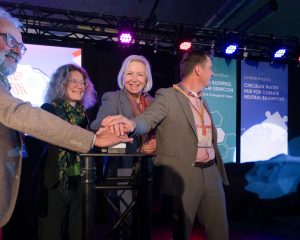
Eindhoven Engine welcomes four new innovation projects valued at over 11 million euros
Eindhoven Engine, the accelerator for innovation projects, welcomes four projects with a focus on energy and health technology: Brain for Buildings, NEON EE, GEM-stage and VIPNOM. The four projects will carry out research worth a total budget of over 11 million euros, with Eindhoven Engine contributing 1.4 million euros. The investment for the Eindhoven Engine OpenCall 2021 comes from the Brainport Region Deal.
The projects can continue to develop under the wings of Eindhoven Engine and get their innovations to market faster. In addition, they will work together at the Eindhoven Engine co-location on the TU/e Campus to help build the internal community.
Brain for Buildings – Automating Performance Assurance Climate Installations
The first OpenCall 2021 project is called Brain for Buildings. The goal is to develop a self-learning module that can monitor and diagnose climate systems in large buildings. This will enable a climate system to perform better; for instance, lower energy consumption, better thermal comfort and better air quality. More efficient maintenance is also possible. The module will be used as an add-on for the Building Energy Management System (BEMS) of offices. The partners in this project are AirTeq, ArtEnergy, Avans, BAM, Building G100, CEO, ChessWise, DWA, DYSECO, Kropman, Peutz, Renor, Royal HaskoningDHV, Sensing 360, Strukton, TNO, TU Eindhoven and WOI.
NEON EE – New Energy Outlook for the Netherlands Eindhoven Engine
The second project is NEON EE, part of the NEON research program that focuses on the societal challenges of climate change, clean energy and smart mobility. The models, or digital twins, being developed provide information on ways to reduce CO2. With the information acquired, research is being conducted into a low-carbon future through realistic and cost-effective ways. NEON EE will enable these models to be brought to market even faster. Within Eindhoven Engine, several parties will test the tooling, nourishing it with more and more data and therefore enabling it to present an even more realistic picture. Partners in this project are Fontys, Lightyear, TU Eindhoven and Zenmo.
GEM stage – Demonstration of Green Energy Mill stage
Large events, such as festivals, consume more electricity than the main grid can supply. As a result, festivals rely on generators that consume up to 130,000 liters of diesel per event. With more than 12,000 large outdoor events in Western Europe each year, it is essential to find ways to reduce this waste and pollution. The GEM tower has been developed to change this. This tall tower is a large battery that controls the storage and distribution of renewable wind and solar energy. In this project, GEM-stage wants to complete the supply of renewable sources in the GEM-stage by adding hydrogen. The partners are DENS, Double2, Flexotels, TU Eindhoven, and ZAPConcepts.
VIPNOM – VIrtual Position NOise Measurement
VIPNOM focuses on the further development of methods to measure noise. Noise is the second largest harmful environmental factor in Europe and claims a million healthy years of life each year due to stress and sleep disturbances. To effectively combat unwanted noise, it is important to be able to measure it. Today, noise is measured by placing microphones at relevant locations. With microphone arrays at central locations, noise levels at several desired locations can also be measured simultaneously. To date, similar measurement methods have been developed. In order to accurately measure noise levels, VIPNOM will further develop, optimize and implement these methods. The resulting algorithms will be tested in the living labs Stratumseind and Strijp-S. GNResound, Sorama and TU Eindhoven are the partners in this collaboration.
Common goal: accelerate innovation
For OpenCall 2021, which calls for projects to come up with innovative proposals that address societal challenges, Eindhoven Engine selected four projects following an evaluation based on predefined criteria by a team of independent experts.
Bert Pauli, chairman of the supervisory board of Eindhoven Engine, is pleased: “Our criteria focus on how innovations can be brought to market faster and more successfully. Only high-quality project proposals are honored. You notice that partners and consortia increasingly find their way to Eindhoven Engine and come up with excellent proposals in order to benefit to the fullest extent from our co-location and potential cross-sector collaborations.”
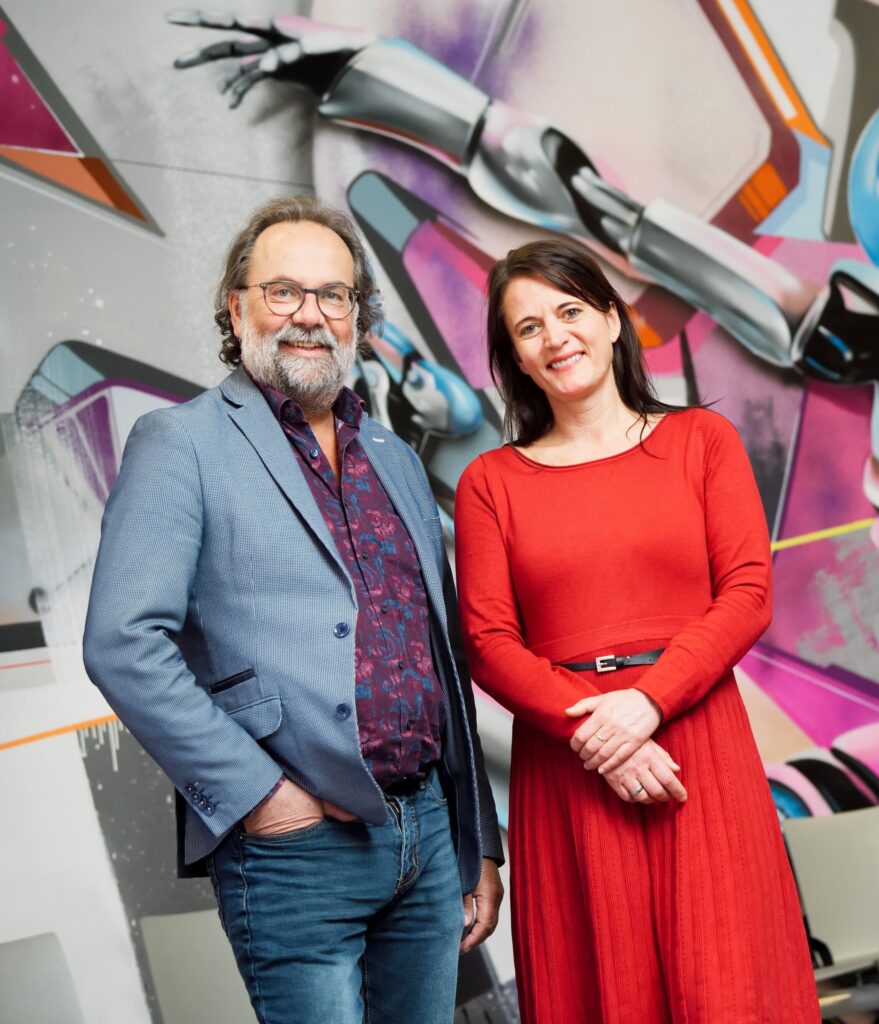
“The projects at Eindhoven Engine have a common goal: to accelerate innovation in the Brainport region.”
– Maarten Steinbuch
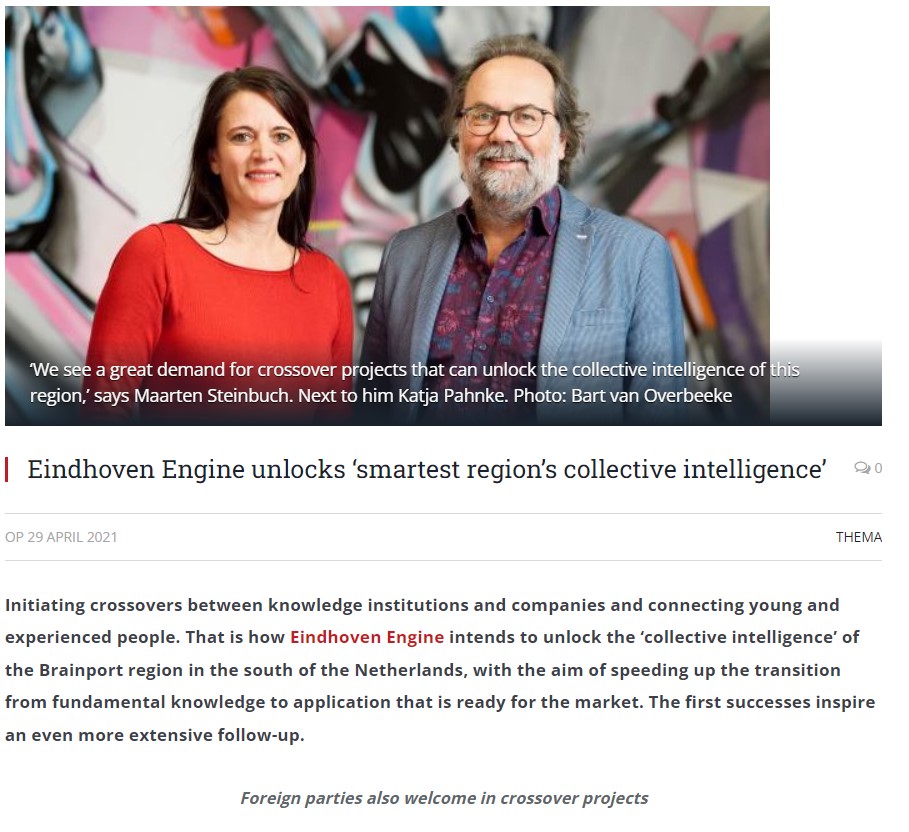
Katja Pahnke and Maarten Steinbuch, directors of Eindhoven Engine, agree wholeheartedly. Steinbuch: “The projects at Eindhoven Engine have a common goal: to accelerate innovation in the Brainport region. They achieve this with research into high-quality technological solutions, facilitated by Eindhoven Engine. And these solutions answer the societal challenges facing our generation and environment.” This is also reflected in the themes of these projects: energy and medical technology. “In view of the relaxations that are increasingly being introduced in the Netherlands,” adds Katja Pahnke, “we are ready to welcome these and also the ongoing projects at our co-location of Eindhoven Engine on the TU/e Campus.”
Giving access to life-long learning for everyone.
Eindhoven Engine (Academy) submitted a challenging project to the PDEng Challenge of TU/e, for the PDEng trainees to get their minds around in a week’s time. The challenge took place from 21 – 25 June. Eindhoven Engine wants to use the output of this Challenge, in order to define, in close cooperation with the Eindhoven Library, a demo project around the library of the future, life-long learning and eradication of low literacy in the region.
Continuous learning hub of the future
The Library’s report: ‘Getting to your core in the heart of the city’ contains a rich palette of options for evolving the Library into a continuous learning hub of the future. Given that this study is based on an extensive survey, there are many ideas of (potential) users, which makes the project a real bottom up experiment of innovation. Today, it seems that there are three significantly developed central ideas to explore further: the role of and the potential for life-long learning for the library; guiding the low-literate into the opportunities and possibilities of life-long learning; the evolution towards a digital library and the inclusion of the ‘ less digital’ in this development. Life-long learning does not only seem to us to be an impactful approach to this project, but it is also close to the heart of our parent institutions (TU/e, Fontys and TNO), and indeed to society.
If we take a closer look at the report, we may be able to identify a few interesting lines of research and development, which Eindhoven Engine would like to deal with in a demo project, in cooperation with the Library and the communities. This PDEng Challenge is intended to create some interesting, creative ideas that might help informing this project.
Accessibility of information
There is a lot of information available (in general, in the world), but how accessible is that information to someone who does not ‘know’, the ‘searcher’ so to speak? Maybe AI (semantics) can do something about this? The speed of (especially social) media also contrasts with the ethical dimension of its use. It is rightly suggested that the library can and should play a trust giving role in this forest of information, fake news, and alternative truth. Also, it could help people on their way from information, to knowledge (what can I do with it) and ultimately to wisdom (was is sensible and has an impact; what is ‘right’ to know or to do). That dimension, from information to knowledge and wisdom, seems to us a useful one to look at how life-long learning can be defined within the current context.
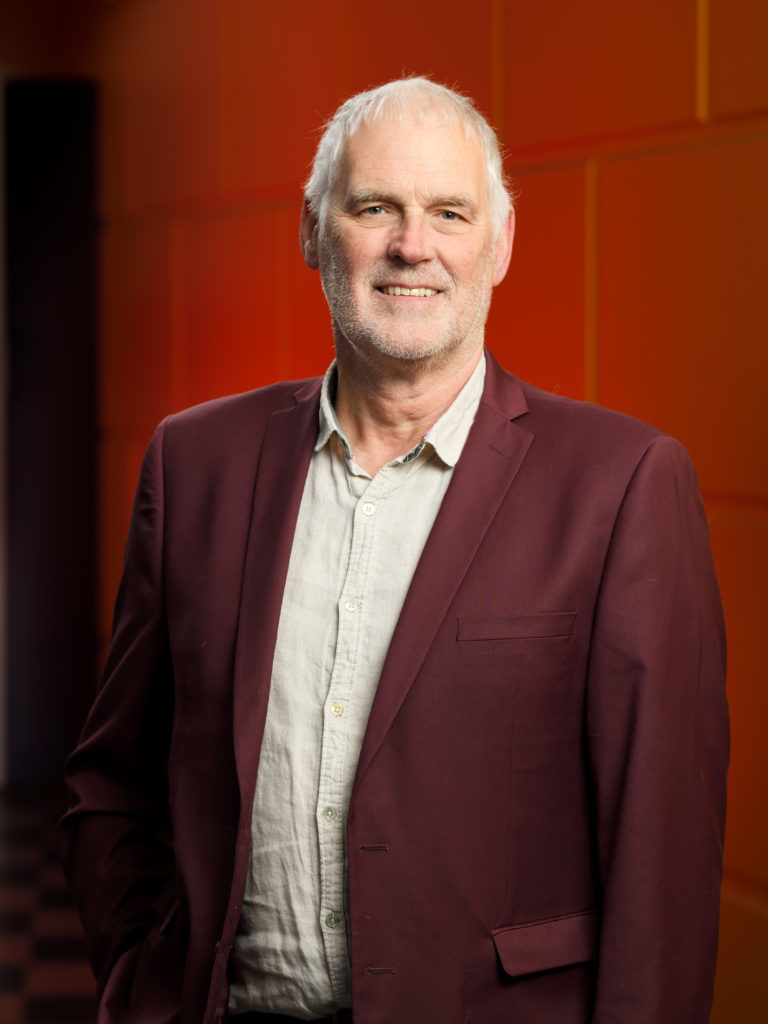
“We are eagerly waiting for the outcome of this Challenge.”
Walter Baets
Eindhoven Engine Academy
Output during PDEng Challenge
During the PDEng Challenge, a team PDEng trainees gave this topic its full attention and creativity for one week. The output of this week will then be used as input for a series of brainstorm sessions with all stakeholders: library, researchers, communities, low-literate. Next, this learning community will deliver the definition of a demo project of the Eindhoven Engine, in cooperation with the Library. Questions that might be interesting to explore are:
- Life-long learning for those that did not receive higher education: what does that mean?
- Identifying the mismatch between the library user and the total population (the potential)
- Why is it so hard to reach some potential user groups?
- What will the online library of the future look like?
- How do you turn the library into a living community, focused on learning? How do you get everyone to connect to it?
- What is the possible role of (on-line) social platforms?
- What is the role of a physical (co-)location?
The course that gets you on track in this exponential world
The Academy of Eindhoven Engine has received a grant of €50,000 from Stichting Post-Academisch Technisch Onderwijs (PATO) to develop the course ‘Business Model Innovation in an Exponential World’. The course comes in two variants: one oriented towards flexible, virtual delivery (while still interactive) and one oriented towards a more impactful, face-to-face delivery.
The project is to develop a new and unique (and therefore currently non-existent) training course for post-academic and post-HBO engineers that contributes to becoming more effective as leaders in the (exponential) technology sector. The aim is to share the latest and newest insights on the success of innovation ecosystems, agile innovation and improvements to time to market, bringing technological evolution closer to business practice. The training and its focus on innovation acceleration is relevant to all engineering specializations (or otherwise technology-trained professionals) who have an interest in making more effective use of the available technology. It contributes to an understanding of how to create impactful, scalable and economically-viable solutions based on the potential of exponential technologies, supporting participants to become leaders in their respective fields.
“The training course targets engineers who are currently in practice as well as academics or
researchers with the ambition to create more market impact.”
Walter Baets – Eindhoven Engine Academy
Bridging the gap
The training course aims to bridge the gap between research and the need to bring technology to the market meaningfully. It targets engineers who are currently in practice as well as academics or researchers with the ambition to create more market impact. As Eindhoven Engine – a collaboration between Eindhoven University of Technology (TU/e), Fontys and TNO – is the organizing party and enjoys very good cooperation with industry, we have direct, easy access to the desired population in the Brainport Region.
Post-academic and post-HBO
We see a few applications of the course being developed, both in Eindhoven Engine itself and for its constituent members (TU/e, Fontys, TNO). Firstly, the training course can be offered by Eindhoven Engine to the post-academic (and post-HBO) community of engineers in order to train them in the latest insights on agile innovation and multidisciplinary applied research. Secondly, we can make the course available to projects that are currently operating within Eindhoven Engine in order to boost (and accelerate) the current innovation approaches. Eventually, we could make the training course available to students (such as PDEng trainees) in order to train them in bridging the gap between their technological expertise and corporate needs.
The course will be constructed in two variants. The first variant will lead to a short course that can be delivered virtually in blocks of five times two hours, with different sessions of group work on an assignment in between. This is a compressed form of the full five-day certification course, which will be the second variant. The short virtual course will start in December 2021. Information about registrations and other details will follow soon. The full five-day course is planned to take place in the first quarter of 2022.
Photos: Bart van Overbeeke
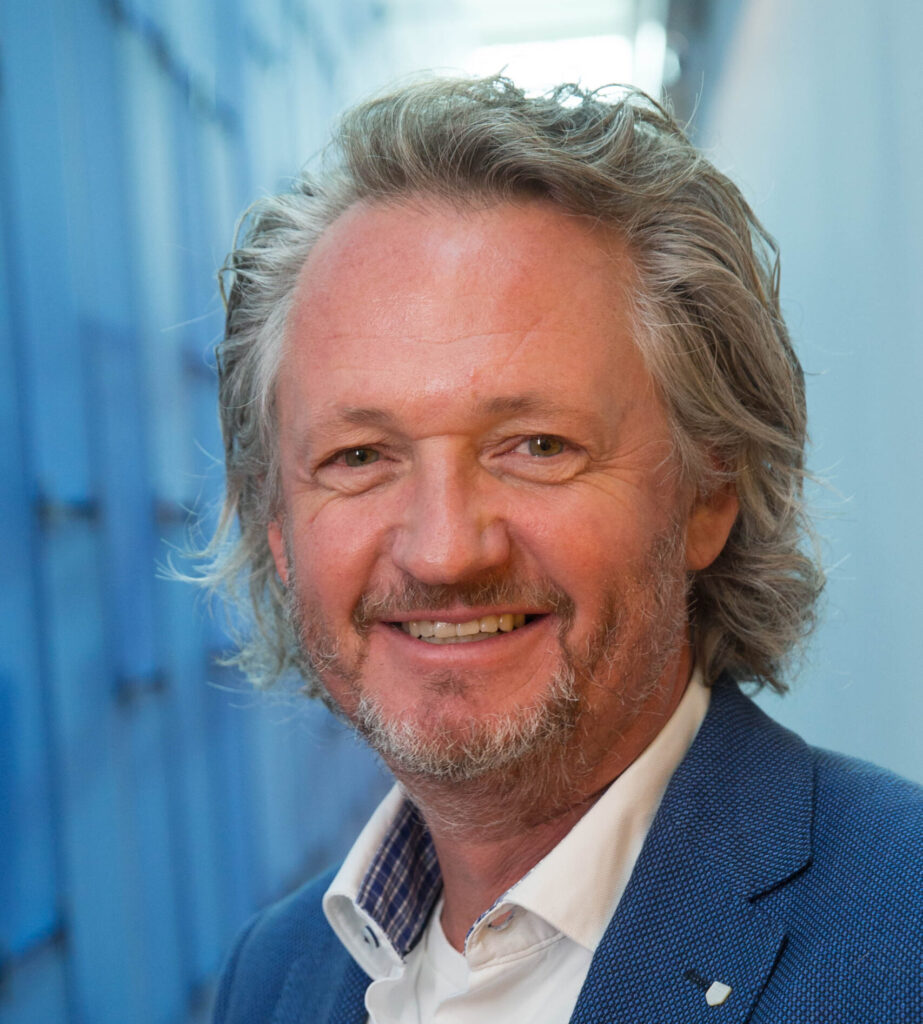
I’m Ralf Zelders, tech-savvy Value Additor, skilled in solving business challenges in the areas of Strategy & Change and (new) Business Development & Innovation with 30+ years of management experience in delivering impactful solutions to challenges in complex and dynamic environments for teams up to C-level management of large corporates.
Over the course of three months, I’ve been supporting Eindhoven Engine’s management – Katja Pahnke (CEO) and Maarten Steinbuch (Scientific Director) – and the team in incorporating and boosting the business innovation perspective of activities at the Engine. The first challenge we explored is the highly successful Eindhoven Engine formula and raising the question of how to sustain and expand funding for the future. The second challenge was how we can incorporate and deepen business model development and innovation earlier in the market readiness levels of projects. And the third was how we can support projects earlier in relation to specific business and market challenges.
The set-up of the Engine formula and the drive and energy the people bring is truly inspiring to me. I value independent thinking in combination with cross-functional and cross-domain team collaboration in order to reach results with an impact. Working pragmatically; hands-on with a ‘can do’ mentality. A great environment with the opportunity to experience and apply my value-adding skills from a business perspective and learn more about the high-tech innovation challenges that the Brainport region and Eindhoven Engine are trying to solve in a shortened timeframe.
If you’d like to know more about my way of working, feel free to contact me: www.linkedin.com/in/ralfzelders
The show is part of the Dutch Technology Week program and is in Dutch
Smart use of technology to boost vitality – Fontys, imec, TNO, Eindhoven University of Technology and Eindhoven Engine cooperate in the FITT and POWErFITTing programmes, forming a strong regional ecosystem. The common goal is to combine their extensive knowledge and experience to develop real-life, innovative and effective solutions to create a vital working environment. New technologies are researched and developed to come up with new technologies that really focus on the working individual and his or her needs.
In this talkshow Maarten Steinbuch (Scientific Director Eindhoven Engine), Steven Vos (professor at Eindhoven University of Technology and Fontys), Sywert Brongersma (Director Strategic Partnerships imec), Marieke van Beurden (Program Director Human Vitality & Technology at Eindhoven University of Technology) and Pieter Jansen (HC Oranje Rood) will share their vision on the future of our way of working and the part that technology plays. We will kick-off the POWErFITTing programme and you can watch live demos of innovative solutions based on smart technologies that are available today.
Eindhoven Engine accelerates innovation in the Brainport region through challenge-based research in its public-private research facility at the TU/e Campus. Teams of our region’s most talented researchers from industry, knowledge institutes and students cooperate in Eindhoven Engine research programs to deliver breakthrough technological solutions.
In the Smart Mobility project the goal is develop new perception technology for next-generation automated driving systems. The project focusses both on sensors, by researching and prototyping new imaging radar systems, and on artificial intelligence, by researching highly-efficient deep binary neural networks that can interpret sensor data. This project is a collaboration of TU/e and NXP and supported by Eindhoven Engine and AI in Motion.
Watch here the broadcast ‘Smart Mobility @Eindhoven Engine‘ recordered during the Dutch Technology Week 2021 and TU/e professor Gijs Dubbelman will explain how this particular project @Eindhoven Engine accelerates innovation.
Publication: LINK Magazine South Netherlands edition 2021
This month, April, we received a record number of 33 notifications for the Eindhoven Engine OpenCall 2021. We look forward to receiving the final project proposals, which are due on May 13, 2021, at 17:00 CET. Our expert team will make a selection after a careful process. The outcome is expected in late June.
In this edition of the Newsletter, you can read the first section of a two-part interview with Jan Mengelers, a former member of our Superadvisory Board. Jan gives insight into his views on Eindhoven Engine and its rise. This edition also contains the Triple Helix collaboration in the SBIR medical isolation gowns project, the kick-off of the ‘Future of Work’ demo project, an update on our community building, the progress report of Regio Deal Brainport Eindhoven and an introduction to our intern Martijn de Kleijn.

Eindhoven Engine: creating an innovation powerhouse
Second section of a two-part interview. Read here the first section.
“The scientific and technological scenes in the Netherlands grew too much apart. There are now three worlds which almost coexist next to each other: industry, universities and institutes like TNO. In order to take theoretical discoveries from universities and turn them into applied technical solutions for the market and industry, these three worlds should ideally work closely together with each other. Due to several causes, there is too little symbiotic merging of cooperation, although there are a few examples in which it is organized in an excellent way. This general trend is problematic because you need a seamless transition from TRL 1 to TRL 9 in order to successfully innovate. I am convinced that Eindhoven Engine is an essential solution to this dilemma.”
It’s early spring. The weather shifts through all seasons at a rapid pace. Tucked in our winter coats, we take shelter under the broad canopy in front of the main building of Eindhoven University of Technology. Jan Mengelers is quite familiar with this scenery: until mid-2019, he was president of TU/e. He is now one of the initiators of Eindhoven Engine and served as a supervisory member of our board until 1 March 2021. We took this opportunity to ask him how he came up with the concept of Eindhoven Engine.
Multidisciplinary teams bridge the gap
“During my presidency of TU/e, I found that multidisciplinary student teams like the Solar Team Eindhoven can solve challenging problems. Just let them create a team of excellent students, organize funding, lower organizational barriers and challenge the team with inspiring ‘moonshot’ goals combined with nearly impossible deadlines. This way, you can create a ‘vibe’ in a team, an unforgettable experience which they will talk about for years.
“This is how I myself was part of the team that built the Volvo 440. We created a team which was solely dedicated to designing a new car. They operated out of some old barracks in England, far from the main organization, far from the organizational rules. This created an atmosphere of ‘us against the world’. They managed to creatively solve all technical problems and create an inspiring product and an everlasting team spirit.
“Challenge them with a nearly impossible deadline to come up with a meaningful solution that society can benefit from in everyday life.”
“I wanted to implement this concept of multidisciplinary teams according to the concept of student teams in order to bridge the gap between the university and industry. Give teams of brainiacs from both worlds a big hairy problem to sink their teeth into. Challenge them with a nearly impossible deadline to come up with a meaningful solution that society can benefit from in everyday life. “The thing that was missing was a name. We ‘borrowed’ the word ‘engine’ from MIT and we added the word ‘Eindhoven’ as we are stationed here. That’s how the plans for Eindhoven Engine saw the light of day.”
A running start
“So, when the Dutch government granted the regional deal and Brainport Eindhoven received its investment of 130 million euros, we had already done our homework. We could just send in the plans for Eindhoven Engine. We got the approval and were able to start executing.
“I envisioned an eleven-story-high building here on campus. The building would not only contain office spaces and labs but also apartments for short-stay residence. Every floor with its own scientific topic and project. “This idea has not materialized yet. But as you know, Eindhoven Engine has found a perfect home in the MultiMediaPaviljoen on the campus, where multidisciplinary Eindhoven Engine teams work on finding technical solutions with societal impacts. And maybe the big dream of the eleven-story-high building will be realized when the Eindhoven Engine has become an enormous success.”
Finding the right people
“An inspiring place to work is important, but our concept stands and falls on attracting competent and inspiring people. That’s why I am so excited that Maarten Steinbuch and Katja Pahnke agreed to join Eindhoven Engine. Maarten has the ability to recognize potential ideas which can be developed for the market and has the suave and intelligent manner needed to make connections between science and industry. Combined with Katja’s ability to structure concepts and arrange an operation smoothly, we have an ironclad team which can make Eindhoven Engine a success.
“Also, the partnerships with Fontys and TNO are a tremendous asset. Although our students at TU/e are well-equipped to formulate a research and development goal, they also need people who excel in executing and developing that goal. This makes the students of Fontys a perfect match. The expertise of TNO is in creating continuity in research programs. This key expertise is what is needed to overcome one of the hurdles that Eindhoven Engine will have to jump in the years to come.”
“The partnerships with Fontys and TNO
are a tremendous asset.“
The challenge of creating continuity
“The challenge is to create continuity in the program as well as in funding. It is hard to create continuity if there is no basic funding from the government. To keep these kinds of initiatives afloat, you need thirty percent of your revenue as a structural grant from regional or national governments just to pay for your indirect structural costs.
“Continuity in the program is also quite difficult. It’s in the nature of researchers to shift their focus after finishing a project and follow their interests. Besides that, it’s hard to give it your all for three or four years. You can preserve the vibe, but it is hard. When the Volvo 440 team finished the task, we wanted to inject their spirit and vibe into the main organization. It did not succeed. Their success brought them to ‘a building with marble stairs’; they wanted to enjoy the reward they had earned and became part of the regular organization again.”
Eindhoven Engine international
“If Eindhoven Engine succeeds in building a continuous research program with their stakeholders (shareholders, industry and government) and keeps the course they have planned out, I am convinced that they have the ability to blow the competition out of the water. I always dreamt of taking the concept of Eindhoven Engine to an international level. Imagine what kind of powerhouse we could build if we created a European Engine with our partners among the EuroTech Universities.”
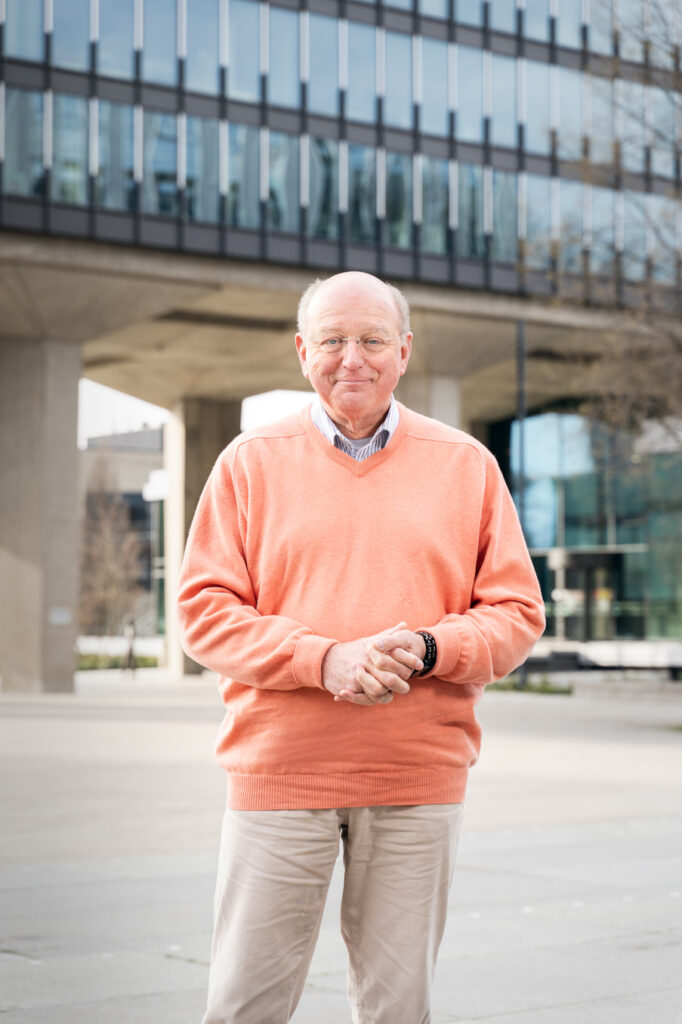
“Imagine what kind of powerhouse we could build if we created a European Engine with our partners among the EuroTech Universities.”
The community is gaining momentum; more and more Engine members are finding each other. We will keep organizing activities and workshops to help them to accelerate their projects. As an example, we changed our February webinar to a more interactive format and it was a great success. During the webinar, Lyla and Jasmijn Kok from the Juno Perinatal Healthcare project pitched their artificial womb and the community provided them with valuable input from their own experiences. That’s what it’s all about: sharing success and challenges and helping each other move forward.
For the next webinar for the Eindhoven Engine internal community (29 april 2021), Professor Hans Krikhaar of Fontys University of Applied Sciences will present the SmartMan project. I hope to see the internal community there to help Hans in his mission to accelerate technological innovation in manufacturing in small and medium-sized enterprises (SMEs).
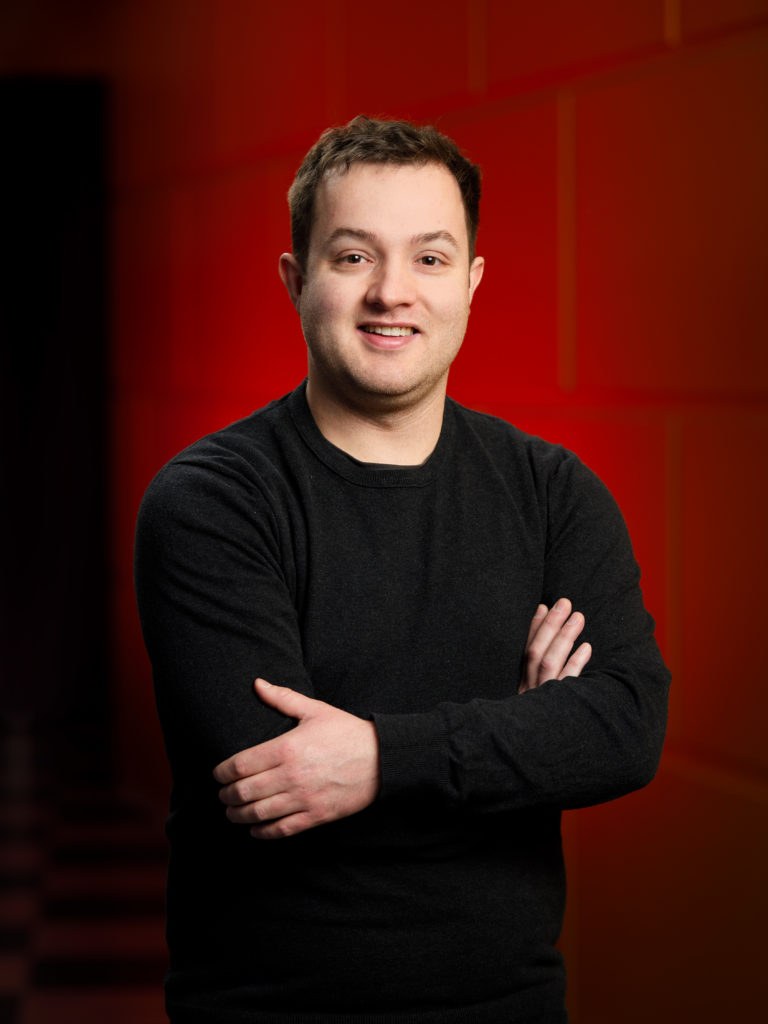
“That’s what it’s all about: sharing success and challenges and helping each other move forward.”
Joris Dufils
Eindhoven Engine Community