Welcome our new EngD trainee: Ana Hernández Madonado
We are excited to welcome Ana Hernández Madonado, who joined the Eindhoven Engine team last year as part of the Mechatronics System Design EngD program. As an EngD trainee, Ana is contributing to an impactful in-house project focused on accelerating the transition toward a climate‑neutral Brainport region by 2040.
Ana’s project is in close cooperation with Rijkswaterstaat TU/e and Eindhoven Engine. The work began with an exploration of opportunities for water reuse and regeneration within the Brainport region. Building on these early findings, Ana is now conducting an integrated systems analysis to better understand how natural systems, regional infrastructure, and human activities interact.
Her research involves defining system boundaries, mapping key actors, and identifying critical interdependencies across the region. This integrated approach supports the development of a shared regional understanding, an essential step for effective collaboration between stakeholders.
Supporting the Brainport region’s climate-neutral future
The insights from this project will help guide the Brainport region in its transition toward climate neutrality, providing a robust foundation for informed decision-making and future sustainable solutions. By emphasizing system integration and stakeholder alignment, Ana’s work underscores the vital role of collaboration in achieving long‑term environmental impact.
We warmly welcome Ana to Eindhoven Engine and look forward to following her contributions throughout her EngD journey!
Eindhoven Engine receives another 50K to accelerate climate‑neutral Brainport region by 2040
We are proud and delighted to announce that our project Brainport Circulaire Waterhub – From Isolated Initiatives to Collective Water Management has been awarded a 50K Kennis‑in‑Actie grant for Collectief Waterbeheer Oost‑Brabant. This support marks an important milestone in our joint program with Rijkswaterstaat to help the Brainport region become climate neutral by 2040.
A shared challenge, a collective opportunity
The rapidly growing Brainport region faces a significant water challenge. Urban expansion, industrial demand, and the effects of climate change mean that by 2040 we must retain more water locally and extract far less. At the same time, our region is uniquely positioned to lead the way. Brainport’s strong collaborative culture, where government, businesses, knowledge institutions, and society work hand in hand, creates fertile ground for innovative solutions.
This project embraces that strength. Together, we aim to transition from fragmented water initiatives to a cohesive, future-proof model of collective water management. Our ambition is to enable the same water to be used multiple times across companies, public authorities, agriculture, and households, before returning it to nature in the highest possible quality.
Collaboration at the heart
Eindhoven Engine will serve as project lead, working closely with a diverse and committed consortium:
- Eindhoven Engine
- Kloostersland
- Sustainable Dynamics
- TU/e Industrial Engineering & Innovation Sciences
- TU/e Mechanical Engineering
- vanderPoll office
This powerful coalition embodies the Brainport spirit: multidisciplinary, innovative, and united by a common purpose.
Ambition in action
This six-month exploratory project started in February 2026 and brings together technical expertise, scientific insights and practical experience. Through co-creation, we will investigate the process step to create a regional circular water system with stakeholder, laying the groundwork for broader implementation across Oost‑Brabant.
The grant enables us to deepen this journey and make the lessons learned available for other locations.
Climate-neutral Brainport 2040: Circular water hubs
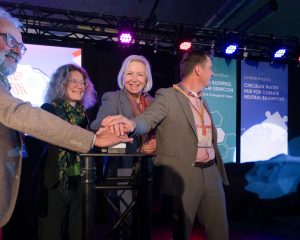
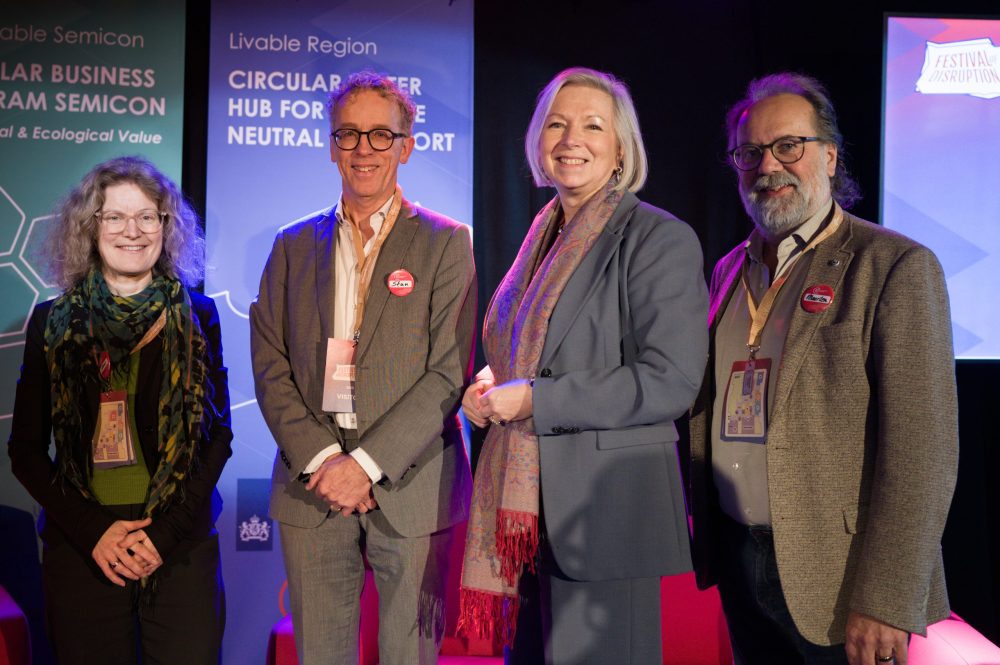
We proudly announce a landmark collaboration between Eindhoven Engine, Rijkswaterstaat, and a coalition of visionary partners. This agreement, officially kicked off during the Festival of Disruption 2025, marks a decisive step toward achieving a climate-neutral Brainport by 2040 through circular water hubs. Among those present at this milestone: Patricia Zorko, Deputy Director-General at Rijkswaterstaat, and Silvia Lenaerts, Rector Magnificus of TU/e.
Why does it matter?
Water scarcity is no longer a distant threat—it’s a pressing reality already impacting the Netherlands, especially during increasingly dry summers. By 2030, we will need an additional 100 million m³ of drinking water every year to meet growing demand. Without bold action, structural shortages could disrupt households, industries, and ecosystems. In the Brainport region, this challenge is even more urgent due to climate change, rapid economic growth, and fragile sandy soils.
Our solution: circular water hubs
We are building a regenerative water system that not only uses water but actively restores and strengthens the natural cycle. Our guiding principle: Every drop you receive should be returned at least as clean—ideally cleaner—so nature benefits too.
This approach connects to other societal challenges such as nitrogen, energy, raw materials, and food. It’s a wicked problem that demands integrated, multidisciplinary collaboration. Eindhoven Engine acts as the orchestrator, leveraging expertise from TU/e, Fontys, Avans, and Yuverta, alongside key partners including businesses, the Ministry of Defence, Brabant Water/Rehydro, and Waterschap De Dommel. Rijkswaterstaat contributes innovationsite Kloosters from InnovA58 and its assets—such as the Wilhelmina Canal and highways—to enable this transformation.
The commitment
The collaboration runs for four years, with the intention to extend. This agreement forms part of Rijkswaterstaat’s sustainability strategy, with Eindhoven Engine leading as regional orchestrator within the University 4.0 hub. A budget of €800,000 has been allocated to kick-start this initiative. By integrating technical, societal and organizational innovations we improve our ability to tackle complex problems.
Every drop you receive should be returned at least as clean—ideally cleaner—so nature benefits too.
Eindhoven Engine News – March 2025
In this edition of Eindhoven Engine News: Innovation accelerator Eindhoven Engine enters new phase, Transforming basic skills support with AI and more!
What else is happening at Eindhoven Engine?
New video: DynaPopeX
In the DynaPopeX project, TNO and Zicht op Data focus on reducing poor air quality. By combining data, location, and human movement patterns in Eindhoven, they develop tangible measures to minimize people’s exposure to harmful particulate matter and limit potential health risks. This is crucial for the municipality of Eindhoven to understand the most significant impacts of air quality and improve the health of its residents.
New interns
Eindhoven Engine welcomed a vibrant group of new interns in 2025. Get to know them from left to right. Additionally, four bachelor students from TU/e have started. Over the coming months, they will focus on the climate-adaptive region, working one day a week.
We wish them good luck! We hope the interns gain valuable experience and bring fresh insights to the various programs at Eindhoven Engine. Everyone can make impact on society!
- Cathelijne Brantjes | Human & Technology, 4th year, Avans University of Applied Sciences | Inclusive Society
Research on making blended care more understandable at general practitioners’ offices for people aged 18-40 with reduced digital skills.
- Hilde Schram | Strategic Communication, HBO Master, Fontys University of Applied Science | Communication
Eindhoven Engine focuses on the complex challenges our society faces. Addressing these challenges requires a specific approach. Hilde is researching how this approach can be tackled through strategic communication.
- Levi Deerenberg | Business Innovation, 4th year, Avans University of Applied Sciences | Livable Region
Develop a concept that reduces energy consumption at the residential towers Luna & Aurora on the TU/e-campus by actively influencing the behavior of the residents.
- Ivory Johan | Business Innovation, 4th year, Avans University of Applied Sciences | Livable Region
Develop an innovative concept to increase the engagement and participation of students and staff on the TU/e campus around sustainability, by connecting them with sustainable innovations in an inspiring way.
- David Rozenberg | HBO-ICT (Software) , 4th year, Fontys University of Applied Science | Inclusive Society
Preparing the MetMij chatbot for deployment and real-world use. MetMij easily directs people with low basic skills to appropriate support agencies.
- Santiago Triginer | Industrial Engineering, 3rd year, Eindhoven University of Technology | Livable Region
Identifying challenges and solutions for solar panel reuse, and exploring how AI can enhance recycling processes.
- Mare Gijsbers | Business Innovation, 4th year, Avans University of Applied science | Inclusive Society
Develop a methodology to effectively and accessibly introduce the ‘Met Mij’ app to users with low literacy, enabling them to quickly and easily receive support to participate fully in society.
- Rosalie Hendriks | Business Innovation, 4th year, Avans University of Applied Sciences | Inclusive Society
Develop a new concept for people with low basic skills between the ages of 18 and 40 in the Eindhoven region, in such a way that these people can independently ensure the security of their financial situation.
Building a Healthier Future
My Journey at Eindhoven Engine
Hello, my name is Golnoosh Sabahifard, and I am currently pursuing my EngD traineeship at Eindhoven Engine. My focus is on the Livable Region program, where I am committed to enhancing the public well-being of residents.
At Eindhoven Engine, our mission is to create a sustainable and livable Brainport region where everyone can live healthily and safely. Our goals include reducing health disparities in neighbourhoods by 20% and adding three healthy living years for every person.
Understanding public well-being
Public well-being is influenced by eight factors: loneliness, stress, fewer years of good perceived health, lack of green spaces, noise pollution, population density, and distance to basic facilities. My research focuses on evaluating the effectiveness of current assessment tools and developing a dynamic model that visually illustrates how these factors interact to affect urban health.

The importance of interactive and dynamic analysis
The built environment significantly impacts public well-being, influencing both mental and physical health. Traditional urban assessment tools often lack interactive and dynamic analysis, making it difficult to estimate the long-term impacts of various elements.
My traineeship aims to change this. I am using Vensim, a visual modeling tool, to provide a data-driven, visual method that helps stakeholders understand how small changes in urban planning can lead to significant health benefits. This approach is crucial for evidence-based urban planning, enabling policymakers to make informed decisions to create healthier, more sustainable cities.
Ultimately, this work will lay the foundation for future research on building healthy and sustainable urban environments.
Science, industry and government seek solution to grid congestion via large-scale living lab on TU/e campus
In the search for solutions to the current grid congestion problem, science, industry, and government are joining forces, killing two birds with one stone.
With the OPZuid project GENIUS, TU/e wants to tackle grid congestion together with companies, municipalities, and the province and, at the same time, set up a sustainable testing ground for relevant future innovations. The starting signal is to commission a battery pack in the size of no less than a sea container for the storage of electrical energy on Monday, 18 November.
The GENIUS battery is essential to a smart control platform that aligns different industrial users, energy sources, and storage systems to prevent energy peaks. The lithium iron phosphate battery contains no cobalt or nickel and acts as energy storage and a control tool. It can coordinate and optimize complex data, allowing it to advise on and anticipate the energy needs of the more than forty faculty and business buildings on the TU/e campus, on which approximately fifteen thousand people depend daily. The energy hub is connected to the public energy grid, allowing energy to be fed back into the grid or shared with users in the local area.
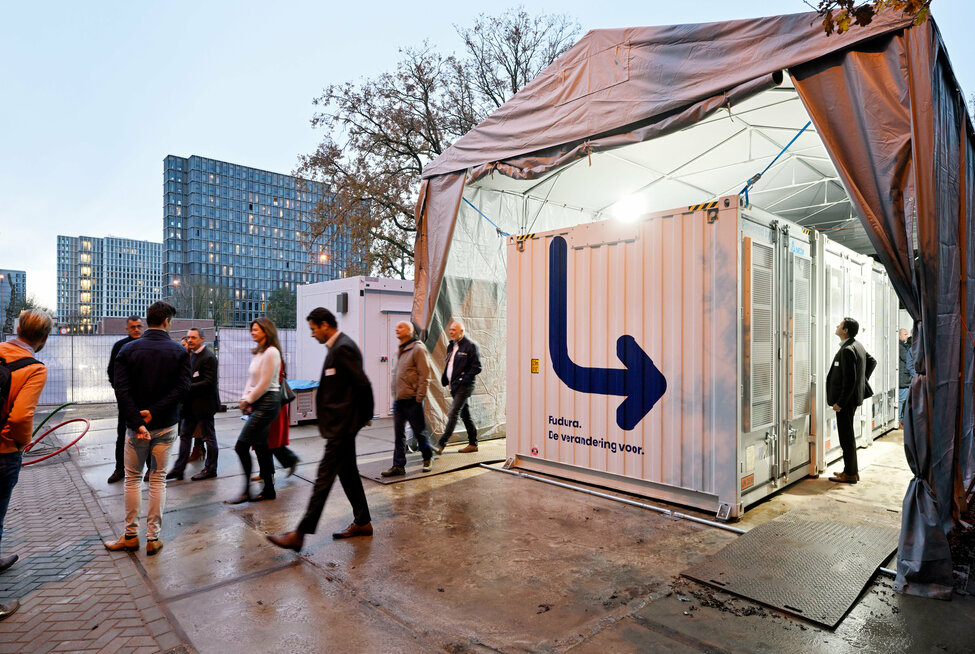
Spreading the rush hour
This battery pack ensures that TU/e no longer causes any exceedances on the contracted capacity and balances the energy consumption better. Simply put, the congestion problem on the energy grid is solved by spreading the morning and evening rush hours. This offers room for further sustainability and expansion of the campus within the current contracted capacity. Think, for example, of heat pumps in combination with Heat and Cold Storage and the arrival of a new clean room.
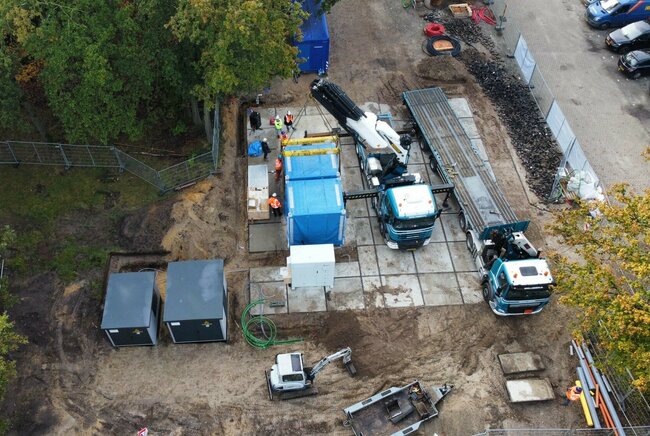
The package easily pays for itself thanks to smart charging and discharging and peak shaving (energy storage when there is little demand and deployment during peak periods). For TU/e, it provides an estimated 20% extra space on its energy grid and capacity because less has to be purchased at unfavorable times (during ‘rush hour’), which lowers the total costs.
This is also beneficial for the grid load in general because TU/e ‘gets out of traffic jams’ at such peak times. More gains can be made in (among other things) the areas of (minimal) CO2 emissions, balancing grid congestion at regional and national levels (TU/e can consume more energy without increasing its connection, leaving capacity for the local area), energy security, peak reduction or the prevention of exceedances on the energy connection.
Blueprint for Dutch industry and grid operators
The system approach not only alleviates the energy needs of the (growing) TU/e campus and distributes them more efficiently but should also ultimately provide a blueprint for Dutch industry and grid operators to tackle grid congestion efficiently. Initially, for the approximately 3500 industrial estates in the Netherlands, mainly in the south of the Netherlands, where grid congestion is slowing down the energy transition and hindering economic growth. That blueprint could then be on the market in four years. This makes OPZuid GENIUS (Grid Efficiency Network Integration for Universal Sustainability) a strategic project with interest from society as a whole, in which open innovation predominates.
In fact, the project functions as a micro-society on campus, providing valuable knowledge about user behavior and how it is influenced and changed by insight into energy use patterns in the long term. This behavioral knowledge is crucial to developing strategies that drive effective behavioral change and promote energy efficiency.
Consortium around OPZuid GENIUS
TU/e President of the Executive Board Robert-Jan Smits: “I am tremendously proud of this project because it brings together a lot of what we stand for as TU/e. With this we are working on sustainability, on solving the grid congestion that all of the entrepreneurial Netherlands is facing, and we are doing this – as a true 4th generation university – in collaboration with a wide range of partners in the region, focused on social impact.”
Mark Cox, Senior Program Manager Energy TU/e: “The GENIUS battery, in combination with intelligent software, can store energy when demand is low so that we can use it during peak times. Thanks to AI, other users, both on campus and in the local area, will not notice this. On the contrary, everyone can benefit from it. When the new Energy Act comes into effect next year, adjacent power grids can be connected. The cleverness of our system approach should then ensure that everyone is always supplied with energy without crossing borders.”
When the new Energy Act comes into effect next year, adjacent power grids can be connected. The cleverness of our system approach should then ensure that everyone is always supplied with energy without crossing borders.
Tom Selten, founder of Simpl.Energy: “With our software, we control the battery, charging stations, and solar panels so that TU/e always remains within the connection. In addition, we optimize the purchase of electricity, thereby minimizing energy costs. And as icing on the cake, with our platform, TU/e has one place where they can see whether all systems are working properly and how much is being earned and saved.”
Daan Pelders, business developer Fudura: “At Fudura, we are proud to be able to participate in this innovative process. We are supplying one of the largest batteries in the Brainport area and integrating it into TU/e’s private grid. We have been TU/e’s partner in energy infrastructure and metering services for many years, and we are grateful for the trust we have received to carry out this project.”
The consortium around OPZuid GENIUS consists of the following parties: TU/e department Real Estate, EIRES, EAISI, Fudura, RIFT, Simpl.Energy, Voltgoed, VBOptimum, ZEnMo, Cube Charging, Enerzien, Eindhoven Engine and Woonbedrijf. An active and connected support group includes the province and municipality, as well as the regional grid operator Enexis. This project was co-financed by the European Union through the award of an OPZuid grant.
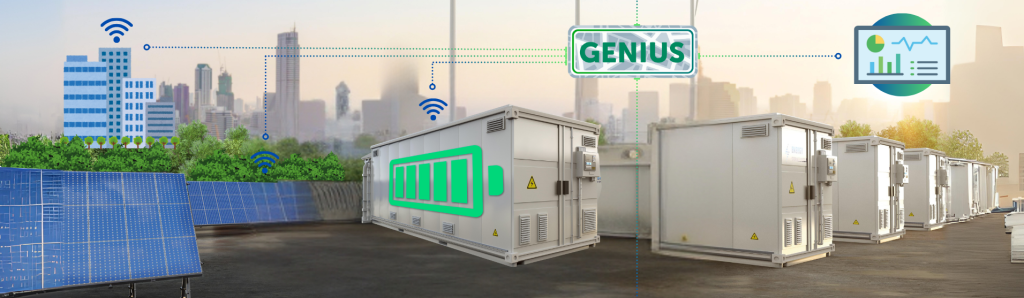

Innovative solution for grid congestion: GENIUS project
As energy demands continue to rise, many regions, including the Brainport region, are facing significant grid congestion challenges. These issues hinder the efficient use and storage of renewable energy, putting strain on the local electricity network. With ambitious sustainability goals in place, there is an urgent need for innovative solutions to optimize energy management and ensure a stable grid.
Introducing the GENIUS project
A promising answer to these pressing issues is the GENIUS project (Grid Efficiency and Network Integration for Universal Sustainability). With €1 million in funding, the GENIUS project is set to pioneer energy efficiency and tackle grid congestion challenges. This initiative is a collaborative effort involving 13 partners, including Eindhoven Engine, and is part of its Livable Regions program
A blueprint for nationwide application
The project aims to smartly address grid congestion, enhance connectivity, and create a sustainable testing ground for innovations. With the GENIUS project, the TU/e campus will become a smart lab for energy transition solutions. Ultimately, this project will served as a blueprint for efficiently managing energy demand. The goal is to develop solutions that can be applied to approximately 3,500 industrial sites across the Netherlands, ensuring a more stable and efficient energy network.
For more details, check out the article published by Innovation Origins.