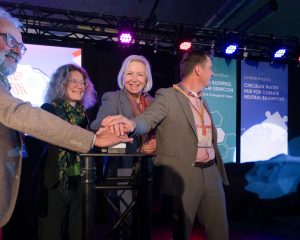
Media: How can we keep Eindhoven’s air as clean as possible?
Anyone who lives in Eindhoven breathes a different mix of exhaust fumes, dust particles and fresh air every day. But where exactly the air is most polluted, and who is most affected, remained unclear for a long time. That’s why the Municipality of Eindhoven, TNO, Zicht op Data, TU/e and Fontys are working together within Eindhoven Engine on DynaPopeX: an innovative approach that shows where residents inhale high concentrations of fine particulate matter and nitrogen dioxide, and how the city can take targeted action.
Thanks to funding from the Regio Deal, these insights are now sharper than ever.
Source: Brainport Eindhoven
Photography: Nick Bookelaar
You can’t do this as a single organisation. The strength lies in the collaboration between the municipality, knowledge institutions and companies, which makes insights faster and more widely applicable.
How healthy is your neighborhood?
A new way to understand urban well-being
Cities are more than just buildings. They shape how we live, feel, and connect. A healthy city offers clean air, safe transportation, green spaces, and opportunities for social interaction. Yet, as urban areas expand, these qualities come under pressure.
By 2050, nearly 70% of the world’s population will live in cities, facing increased noise, pollution, inequality, and stress.
Improve health
To address these challenges, the municipality of Eindhoven launched the Healthy Living Area project, aiming to improve health in neighborhoods. However, they encountered a key obstacle: existing tools focused either on hard data or personal experiences — rarely both. What was needed was a method that could integrate objective indicators with the lived experiences of residents.
In collaboration with the municipality, Eindhoven Engine hosted the EngD project of Golnoosh Sabahifard, embodying its core philosophy: deeply understand the problem before jumping to solutions. A systems overview was essential, beginning with a systems dynamics sketch — the foundation for a model that could later support policy scenarios. Crucially, the project wasn’t done for the people, but with them. Stakeholders were involved in co-creating and validating the systems map, ensuring it reflected real experiences. These principles — co-creation, systems thinking, and problem understanding — are central to Eindhoven Engine’s approach to innovative solutions.

A new approach: Combining data with daily life
With a background in architecture and built environment, Golnoosh brought a systems-thinking mindset to the project. She combined systems dynamics modeling with citizen participation, using the Vensim platform to build a model based on eight criteria — four social and four environmental — already used by the municipality:
Social indicators:
- Socioeconomic status (SES)
- Loneliness
- Stress
- Years in good perceived health
Environmental indicators:
- Green space
- Noise levels
- Distance to facilities
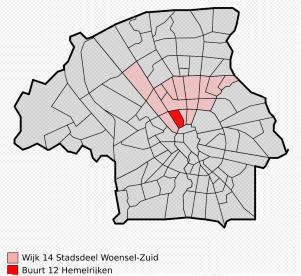
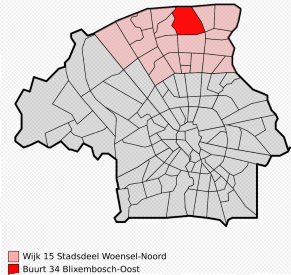
These criteria were applied to two neighborhoods: Hemelrijken and Blixembosch-Oost. The model visualized how these factors interact, enabling comparison and scenario testing. But numbers alone weren’t enough. To capture residents’ perspectives, Golnoosh used the Repertory Grid technique. Participants compared criteria in triads — for example, stress, green space, and noise — and explained which two felt similar and why. This revealed personal constructs like “quiet vs noisy” or “stressful vs calm.” Residents then rated all criteria, adding depth and nuance to the model.
Neighborhood-specific strategy
The findings were revealing. In Hemelrijken, low SES and high stress emerged as the strongest negative drivers of health. Green space and noise were key environmental concerns. Residents confirmed these insights, emphasizing stress, noise, and crowding as major issues. They prioritized solutions such as stress relief, affordable housing, and long-term health support.
In contrast, Blixembosch-Oost presented a different picture. Residents focused more on long-term health, SES, and green space. Loneliness and distance to facilities were more prominent concerns, reflecting the suburban layout. While noise and stress were present, they weren’t central. Residents valued green space and lifestyle health, viewing affordability and density as moderate issues.
These differences highlight a crucial lesson: urban health strategies must be neighborhood-specific. What works in one area may not apply in another. A one-size-fits-all approach simply doesn’t work.
Based on the findings, Golnoosh proposed tailored solutions:
- For Hemelrijken: pocket parks, green roofs, noise reduction measures, affordable housing, and community events to relieve stress and foster belonging
- For Blixembosch-Oost: preserving green infrastructure, health awareness programs, noise buffers, and inclusive community activities
Two additional insights emerged. First, urban health is shaped not just by data, but by people’s lived experiences. Residents often described health in personal terms, such as ‘quiet vs noisy’ or ‘stressful vs calm’. Second, co-creation is essential: involving residents leads to more grounded and accepted solutions.
Finding solutions is easy — once you truly understand the problem.
The next phase
The project didn’t end there. A new team member, Veron Afonso, joined to expand the systems dynamics simulation, bringing an IT perspective. The next phase involves returning to residents for validation and scenario building, continuing the cycle of co-creation and refinement.
This project exemplifies how diverse expertise, citizen involvement, and systems thinking can lead to meaningful urban innovation. As Golnoosh’s work shows, understanding the problem deeply is the key to designing healthier cities. Once the real challenges are clear, solutions follow naturally.
Media: Mijke the Matchbot guides you through the jungle of social organisations
Imagine you have a question about finances, your health, or a difficult letter. But in the maze of social organisations, your first attempt always leads you to the wrong organization. For over three million Dutch people with limited basic skills, this is a daily reality. Many give up out of frustration or shame. Mijke the Matchbot aims to change that: a friendly digital assistant, developed with support from the Regio Deal Brainport Eindhoven funds, that actually points you in the right direction.
Source: Brainport Eindhoven
New video: DynaPopeX
In the DynaPopeX project, TNO and Zicht op Data focus on reducing poor air quality. By combining data, location, and human movement patterns in Eindhoven, they develop tangible measures to minimize people’s exposure to harmful particulate matter and limit potential health risks. This is crucial for the municipality of Eindhoven to understand the most significant impacts of air quality and improve the health of its residents.