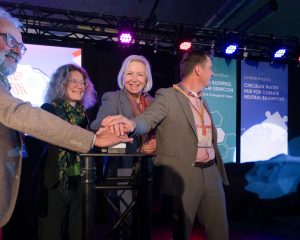
Eindhoven Engine News – October 2025
In this edition of Eindhoven Engine News: Festival of Disruption 2025, How healthy is your neighborhood?, Mijke the Matchbot update & more.
What else is happening at Eindhoven Engine?
Advancing energy flexibility in buildings
Transforming building energy management with smart control systems
The BuildInFlexergy project, funded by the Dutch Mission-Driven Research, Development, and Innovation (MOOI) program, is revolutionizing building energy flexibility. This is supported by the Dutch Ministry of Economic Affairs and Climate Policy and the Ministry of the Interior and Kingdom Relations, and managed by the Netherlands Enterprise Agency (RVO). This four-year industry leading initiative unites 10 industry partners (including Eindhoven Engine) and 2 top universities (TU Eindhoven and TU Delft).
A unified approach to innovation
Coordinated and managed by Kropman B.V., the consortium includes installation companies, energy consultants, platform developers, building owners and managers, technology providers, and other experts. The aim is to foster open knowledge exchange and drive innovation through strategic collaboration and widespread dissemination of results.
Buildings at the heart of the energy transition
As the energy sector shifts towards a decentralized, digital, and low-carbon future, buildings—significant consumers of electricity and thermal energy—are key to providing demand-side flexibility. This flexibility allows buildings to adjust their energy use in response to external signals like electricity prices, carbon intensity, or grid constraints, without sacrificing occupant comfort or essential functions.
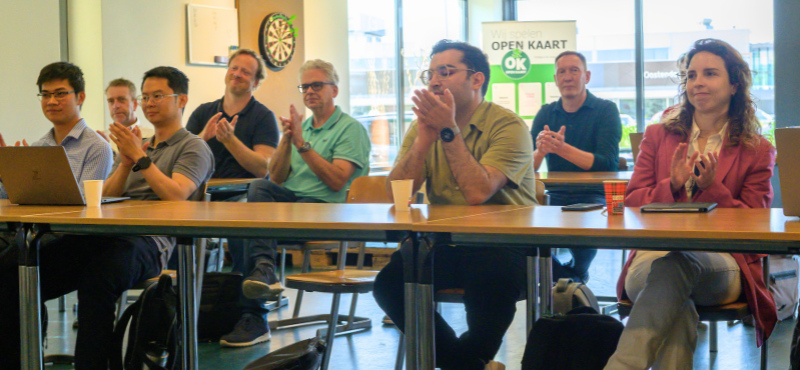
Kick-off meeting 17th June, 2025 | Kropman Nijmegen
The power of model predictive control
Model Predictive Control (MPC) is a cutting-edge tool for optimizing building energy performance. Unlike traditional control systems, MPC uses predictive models and real-time data to proactively manage a wide range of systems, including HVAC (Heating, Ventilation, and Air Conditioning), lighting, heat pumps, thermal storage, electric vehicles charging and other building loads It uses forecasts of occupancy, weather conditions and other relevant parameters to determine the best control actions over a future period, continuously updating the plan based on new data.
The aim of this project is to foster open knowledge exchange and drive innovation through strategic collaboration and widespread dissemination of results.

Real-time responsiveness with dynamic climate control
Dynamic climate control adjusts HVAC settings and ventilation rates based on changing indoor and outdoor conditions. This allows buildings to pre-cool or pre-heat spaces when renewable energy is plentiful or electricity prices are low, shifting loads without compromising comfort or overloading the grid.
Optimizing with key performance indicators
Key Performance Indicators (KPIs) are developed based on the Smart Readiness Indicator. KPIs guide decisions and balance objectives like energy cost, comfort, CO₂ emissions, and grid support. KPIs such as total energy consumption, peak load reduction, indoor comfort indices, and flexibility scores can be prioritized based on goals.
The future of building energy flexibility
The KPI-driven MPC framework makes buildings energy-efficient, grid-responsive, and climate-conscious. This approach is ideal for buildings in smart grids or demand response programs, supporting both building managers’ operational goals and energy system planners’ strategic targets.
In conclusion, combining MPC, dynamic climate control, and KPI-driven optimization can significantly enhance building energy flexibility. This strategy is crucial for making buildings active participants in the low-carbon energy system of the future.
Eindhoven Engine News – June 2025
In this edition of Eindhoven Engine News: Oefenen.nl and Eindhoven Engine join forces, Workshop ‘The Power of Understanding Each Other’, EngD trainee Sichen Guo in the spotlight & more
What else is happening at Eindhoven Engine?
Tackling energy challenges in buildings
The BuildInFlexergy approach
As buildings become increasingly reliant on electricity to maintain their indoor climate, they face challenges such as electricity supply and limited grid capacity.
To address these issues, Eindhoven Engine is happy to announce the BuildInFlexergy initiative commenced on May 1st, 2025.
Focus on energy flexibility
This project brings together 12 partners, including Eindhoven Engine. It aims to enhance the reliability and efficiency of local energy supply by better utilizing energy flexibility. Additionally, this initiative is particularly crucial for large, complex building systems equipped with heat pumps and thermal energy storage. These systems often experience stability and coordination issues, which can negatively impact both energy and comfort performance. Therefore, by focusing on energy flexibility, BuildInFlexergy aims to overcome these challenges and ensure a more stable and efficient energy supply for building.
Smart control systems and model predictive control
By transforming building energy management with smart control systems and model predictive control, we achieve real-time responsiveness and dynamic climate control. Moreover, this optimization uses key performance indicators. This unified approach to innovation places buildings at the heart of the energy transition, paving the way for the future of building energy flexibility.
This project not only addresses current challenges but also sets a precedent for future developments in energy-efficient building management.
Science, industry and government seek solution to grid congestion via large-scale living lab on TU/e campus
In the search for solutions to the current grid congestion problem, science, industry, and government are joining forces, killing two birds with one stone.
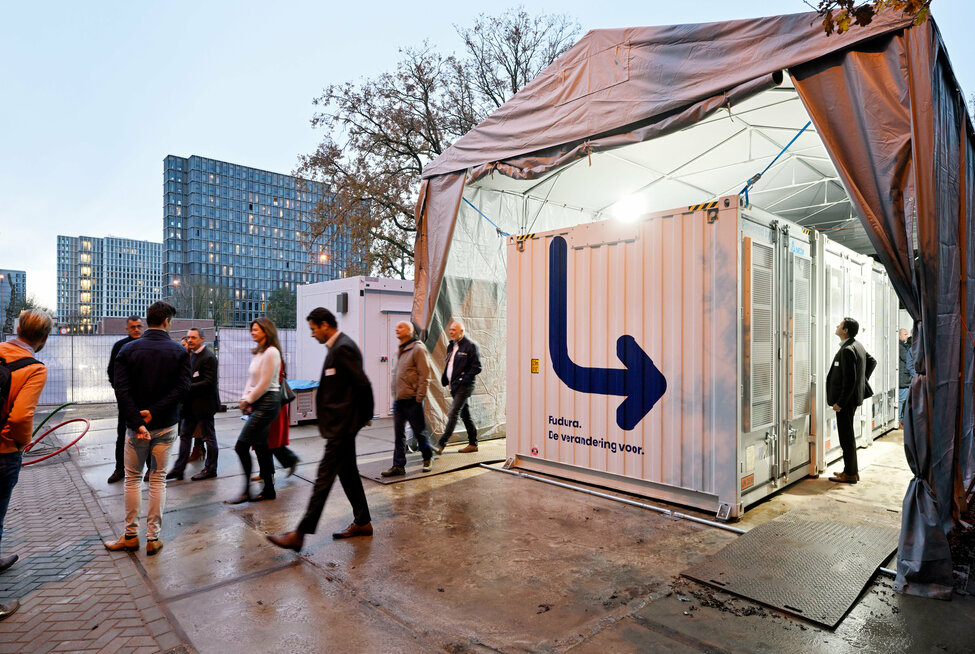
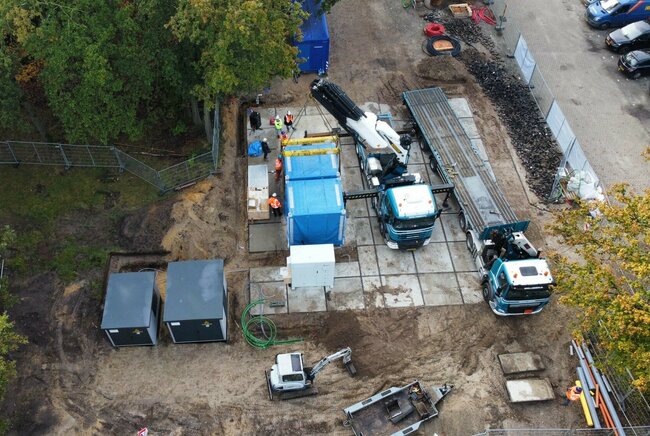
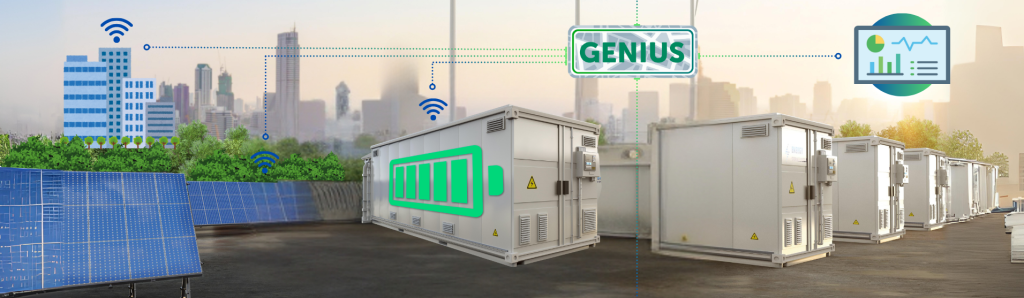
With the OPZuid project GENIUS, TU/e wants to tackle grid congestion together with companies, municipalities, and the province and, at the same time, set up a sustainable testing ground for relevant future innovations. The starting signal is to commission a battery pack in the size of no less than a sea container for the storage of electrical energy on Monday, 18 November.
The GENIUS battery is essential to a smart control platform that aligns different industrial users, energy sources, and storage systems to prevent energy peaks. The lithium iron phosphate battery contains no cobalt or nickel and acts as energy storage and a control tool. It can coordinate and optimize complex data, allowing it to advise on and anticipate the energy needs of the more than forty faculty and business buildings on the TU/e campus, on which approximately fifteen thousand people depend daily. The energy hub is connected to the public energy grid, allowing energy to be fed back into the grid or shared with users in the local area.
Spreading the rush hour
This battery pack ensures that TU/e no longer causes any exceedances on the contracted capacity and balances the energy consumption better. Simply put, the congestion problem on the energy grid is solved by spreading the morning and evening rush hours. This offers room for further sustainability and expansion of the campus within the current contracted capacity. Think, for example, of heat pumps in combination with Heat and Cold Storage and the arrival of a new clean room.
The package easily pays for itself thanks to smart charging and discharging and peak shaving (energy storage when there is little demand and deployment during peak periods). For TU/e, it provides an estimated 20% extra space on its energy grid and capacity because less has to be purchased at unfavorable times (during ‘rush hour’), which lowers the total costs.
This is also beneficial for the grid load in general because TU/e ‘gets out of traffic jams’ at such peak times. More gains can be made in (among other things) the areas of (minimal) CO2 emissions, balancing grid congestion at regional and national levels (TU/e can consume more energy without increasing its connection, leaving capacity for the local area), energy security, peak reduction or the prevention of exceedances on the energy connection.
Blueprint for Dutch industry and grid operators
The system approach not only alleviates the energy needs of the (growing) TU/e campus and distributes them more efficiently but should also ultimately provide a blueprint for Dutch industry and grid operators to tackle grid congestion efficiently. Initially, for the approximately 3500 industrial estates in the Netherlands, mainly in the south of the Netherlands, where grid congestion is slowing down the energy transition and hindering economic growth. That blueprint could then be on the market in four years. This makes OPZuid GENIUS (Grid Efficiency Network Integration for Universal Sustainability) a strategic project with interest from society as a whole, in which open innovation predominates.
In fact, the project functions as a micro-society on campus, providing valuable knowledge about user behavior and how it is influenced and changed by insight into energy use patterns in the long term. This behavioral knowledge is crucial to developing strategies that drive effective behavioral change and promote energy efficiency.
Consortium around OPZuid GENIUS
TU/e President of the Executive Board Robert-Jan Smits: “I am tremendously proud of this project because it brings together a lot of what we stand for as TU/e. With this we are working on sustainability, on solving the grid congestion that all of the entrepreneurial Netherlands is facing, and we are doing this – as a true 4th generation university – in collaboration with a wide range of partners in the region, focused on social impact.”
Mark Cox, Senior Program Manager Energy TU/e: “The GENIUS battery, in combination with intelligent software, can store energy when demand is low so that we can use it during peak times. Thanks to AI, other users, both on campus and in the local area, will not notice this. On the contrary, everyone can benefit from it. When the new Energy Act comes into effect next year, adjacent power grids can be connected. The cleverness of our system approach should then ensure that everyone is always supplied with energy without crossing borders.”
When the new Energy Act comes into effect next year, adjacent power grids can be connected. The cleverness of our system approach should then ensure that everyone is always supplied with energy without crossing borders.
Tom Selten, founder of Simpl.Energy: “With our software, we control the battery, charging stations, and solar panels so that TU/e always remains within the connection. In addition, we optimize the purchase of electricity, thereby minimizing energy costs. And as icing on the cake, with our platform, TU/e has one place where they can see whether all systems are working properly and how much is being earned and saved.”
Daan Pelders, business developer Fudura: “At Fudura, we are proud to be able to participate in this innovative process. We are supplying one of the largest batteries in the Brainport area and integrating it into TU/e’s private grid. We have been TU/e’s partner in energy infrastructure and metering services for many years, and we are grateful for the trust we have received to carry out this project.”
The consortium around OPZuid GENIUS consists of the following parties: TU/e department Real Estate, EIRES, EAISI, Fudura, RIFT, Simpl.Energy, Voltgoed, VBOptimum, ZEnMo, Cube Charging, Enerzien, Eindhoven Engine and Woonbedrijf. An active and connected support group includes the province and municipality, as well as the regional grid operator Enexis. This project was co-financed by the European Union through the award of an OPZuid grant.


Eindhoven Engine News – October 2024
In this edition of Eindhoven Engine News: our participation in Dutch Design Week 2024 with ‘Aahh, ik snap het niet!! workhop, more about the upcoming Festival of Disruption, and project updates!
What else is happening at Eindhoven Engine?
Eindhoven’s Energy Initiative: €50K Boost for Grid Balancing Project
As the year 2024 kicks off, Eindhoven Engine, Simpl.Energy and TU/e EIRES (Eindhoven Institute for Renewable Energy Systems) are joining forces for an Energy Grid Balancing initiative, aimed at addressing the pressing energy challenges faced by the Brainport region. This pioneering project is receiving a boost with a subsidy from the Stimuleringsfonds (Stimulation Fund) of the Metropoolregio Eindhoven (MRE).
Energy Challenges in the Brainport Region
The Brainport region is grappling with energy security challenges on its journey towards a sustainable future. While planned grid investments are crucial, they alone won’t provide immediate solutions. Recognized as the Dutch high-tech industry’s national mainport, the strategic importance of Brainport demands a sustainable approach to powering its economic activities and meeting future energy demands.
The newly enacted Energiewet (Energy Act) in the Netherlands creates an opportunity to infuse flexibility into the electricity grid. The current centrally controlled system calls for operational systems at the campus level to adapt to the evolving energy landscape.
As this project unfolds, it promises not only to meet current energy demands but to also build a resilient and dynamic energy infrastructure for the future.
Collaborative Solutions for Brainport’s Future
In this groundbreaking initiative, Eindhoven Engine leads the way in crafting the playbook for simulation tools in Eindhoven-Oost. Simpl.Energy focuses on an operational monitoring and prediction system, while TU/e EIRES connects with ongoing university research and engages stakeholders for effective project dissemination.
Paving the Way for Sustainable Solutions
The Energy Grid Balancing project shines as a beacon of collaborative innovation, harnessing the strengths of Eindhoven Engine, Simpl.Energy, and TU/e EIRES. With MRE Stimuleringsfonds’ support, this initiative is set to forge the path to sustainable energy solutions, addressing Brainport’s unique challenges and contributing to the broader goals of the Dutch high-tech industry’s energy transition. As this project unfolds, it promises not only to meet current energy demands but to also build a resilient and dynamic energy infrastructure for the future. Get ready for a grid revolution in the heart of Brainport.