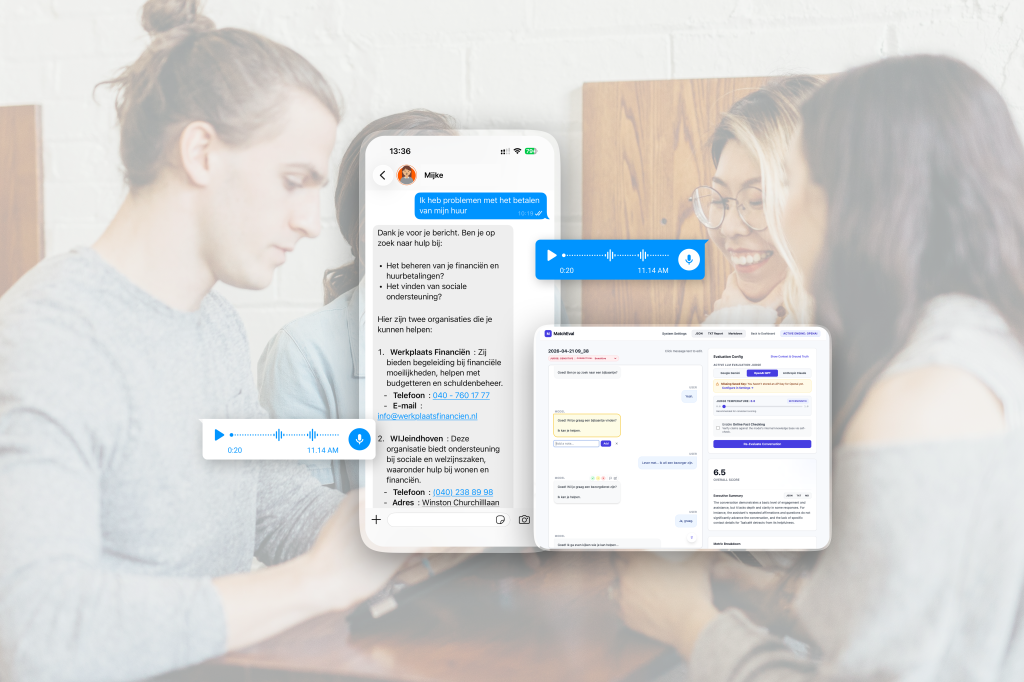
Mijke the Matchbot was developed to address this challenge. Mijke is an AI-powered conversational assistant that helps people find the right support in a friendly and accessible way. Instead of searching through websites or navigating complex systems, users can simply describe their situation and receive guidance towards relevant organisations and services.
Over the past two years, Sichen Guo pursued her EngD traineeship within Eindhoven Engine’s Inclusive Society focus area. In her final year she dedicating her work to optimizing Mijke the Matchbot.

Bridging the gap between people and support
“My research focused on how conversational AI could help people with limited basic skills navigate Dutch social services,” says Sichen. “Many support systems still require people to search, compare, and interpret information independently, which can be challenging when dealing with financial, health, housing, or social issues.”
In her first year Sichen explored simplifying formal letters and service information. With these insights she was able to evaluate Mijke’s effectiveness and better understand user needs. She also focused on voice-enabled communication as a way to make the system even more accessible.
Building responsible AI
As the project progressed, the focus expanded beyond building a functional chatbot. Sichen investigated how such a system could be maintained, evaluated, and responsibly deployed over time.
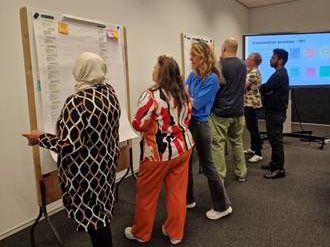
Working closely with libraries, social workers, and other practitioners, she helped define five criteria for high-quality referrals:
- Relevance
- Trustworthiness
- Accuracy
- Clarity
- Completeness
These criteria formed the basis of a human-centered evaluation framework.
One of the most important findings was what Sichen calls the “Fluency Trap.” AI-generated responses can sound convincing, friendly, and professional, even when the information is incomplete or uncertain. This highlights the importance of continuous evaluation and human oversight when using AI in public-service settings.
Looking ahead
- Contact our Inclusive Society Team for more information.