Even more clout for Eindhoven Engine
Fontys, TNO and TU/e joint shareholders.
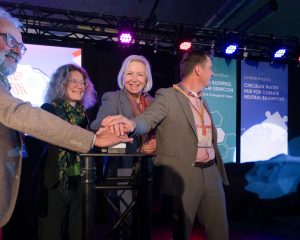
This month Fontys, TNO and TU/e officially became equal shareholders (1/3 each) of Eindhoven Engine. Together the three parties promise to do everything possible to accelerate innovation in the Brainport region. The result is an even better cluster of strengths whereby the innovative business community – from start-up to large company – can take maximum advantage of the available knowledge and skills.
Katja Pahnke, who together with Maarten Steinbuch is responsible for the day-to-day management of Eindhoven Engine, is proud of the result. “In this way we can achieve the intended exponential acceleration of innovation even faster. We connect knowledge institutes to the business community. Stimulate collaboration at a single location. This gives you the intended cross-fertilization between different disciplines.” Maarten Steinbuch adds: “This allows you to benefit from each other’s expertise, network and experience. That acceleration of innovation, that’s what we do it for.”
Ella Hueting, Fontys: “In my opinion, this collaboration is unique. We expect these short lines of communication to be of even greater significance for SMEs.”
Jaap Lombaers, TNO: “We are going to have teams of students from TU/e and Fontys in our innovation programs for and with the industry. In this way we can serve business and industry in the Brainport region in all kinds of ways. We expect that this will enable us to lower barriers and accelerate innovation.”
Eindhoven Engine started in 2019. With support from the Brainport Action Agenda RegioDeal, sixteen projects have been started. The collective ambition is to further accelerate innovation in our region through collaboration and co-creation at a co-location.
Eindhoven Engine
Eindhoven Engine unlocks the collective intelligence in the Brainport region. Thanks to a unique formula, innovators from companies can join forces with students and experienced researchers and employees from knowledge institutions in order to work together to accelerate innovation and realize disruptive co-creation projects in which co-location is a prerequisite. The founding fathers of Eindhoven Engine are the knowledge institutions Fontys, TNO and Eindhoven University of Technology and the companies Philips Healthcare, Signify, ASML, VDL, NTS and NXP. Eindhoven Engine’s funds come from the Brainport Region Deal.
After this unique summer period, life was a bit back to normal at the campus in Eindhoven – at least to a certain extent due to corona and the possibilities for working safely according to the regulations. Following the recent announcements, we are going back to the pre-summer situation but we feel that we are better prepared now. We are eager to boost our virtual meetings with limited activities in co-location in our MultiMedia Paviljoen building, which is now in its final phase of restructuring. We look forward to the finishing line in this process!
In this edition of Eindhoven Engine News:
- Interview with Ella Hueting, Director of Fontys School of Engineering and chairman of Eindhoven Engine’s Advisory Board.
- OpenCall project SoStrap highlighted
- Walter Baets is Making Meaning project with Design Forum
- Collaborative capital: the value of soft skills in technical domains
- and more…
Stay connected with Eindhoven Engine.
Subscribe to Eindhoven Engine News via office@eindhovenengine.nl.
Another step forward for Eindhoven Engine: Fontys University of Applied Sciences and TNO have joined TU Eindhoven as shareholders. “It’s quite a statement,” says Ella Hueting, Director of Fontys School of Engineering and chairman of Eindhoven Engine’s Advisory Board. “I don’t know of any other initiative where all the knowledge centers in the chain are the shareholders and work together with companies in the region.”
Sharing the load
In some ways, this development has been a long time coming. “Eindhoven Engine is about involving students with companies in the Brainport region, which Fontys has done for a long time, especially with SMEs,” Ella explains. “It was very natural for us to get involved.”
By becoming equal partners, she hopes to send a message to the Netherlands that Brainport’s success also lies in knowledge institutes working with both companies and one another. “In engineering, for example, Fontys has almost 1200 students working on projects from about 300 companies each year. When it comes to smaller companies, knowledge is not so available. Should we use robotics, for instance? It’s important for both big and small companies, so we can work on projects where high-level theoretical knowledge comes from TU/e and TNO and Fontys can apply it in smaller companies. It’s very complementary, I think.”
“The projects are even more important than before. Businesses really have to innovate right now.”
A new NatLab
One such example is SmartMan@SME, a Fontys-led project which brings together TNO, VDL and VBTI as partners in OpenCall 2020. This aims to improve factory efficiency by optimizing production processes for SMEs. “It’s not one fixed research project but rather smaller projects which we work on together,” notes Ella. “It’s a question of the company itself, which asks us to help them apply a new technology. We then work on it together with a couple of students. TU/e students have a high theoretical level and some of them really want to apply this too, so all our knowledge is now connected. It’s wonderful!”
Success in SmartMan will be measured in terms of the economic value of improvements per project and company but could also represent the start of something bigger. Ella: “With Eindhoven Engine, I think Maarten [Steinbuch] wanted to achieve a new NatLab. This could be the first step. I’m really enthusiastic about this project, which I think is unique. Now we’re started, I think we’ll achieve big success – particularly in this corona time.”
Opportunities and exposure
In keeping with the forward-thinking nature of Eindhoven Engine, Ella prefers to view the ongoing pandemic in terms of new possibilities. “The projects are even more important than before. Businesses really have to innovate right now. In Brainport and the Netherlands, we need to be challenged to work together and quickly bring new technologies to the market. This might be an opportunity because it’s something we’re good at, and it could give us a big advantage compared to other countries. After all, we have a lot of international students who know that this region is the place to be. Eindhoven Engine creates exposure for what we can do.”
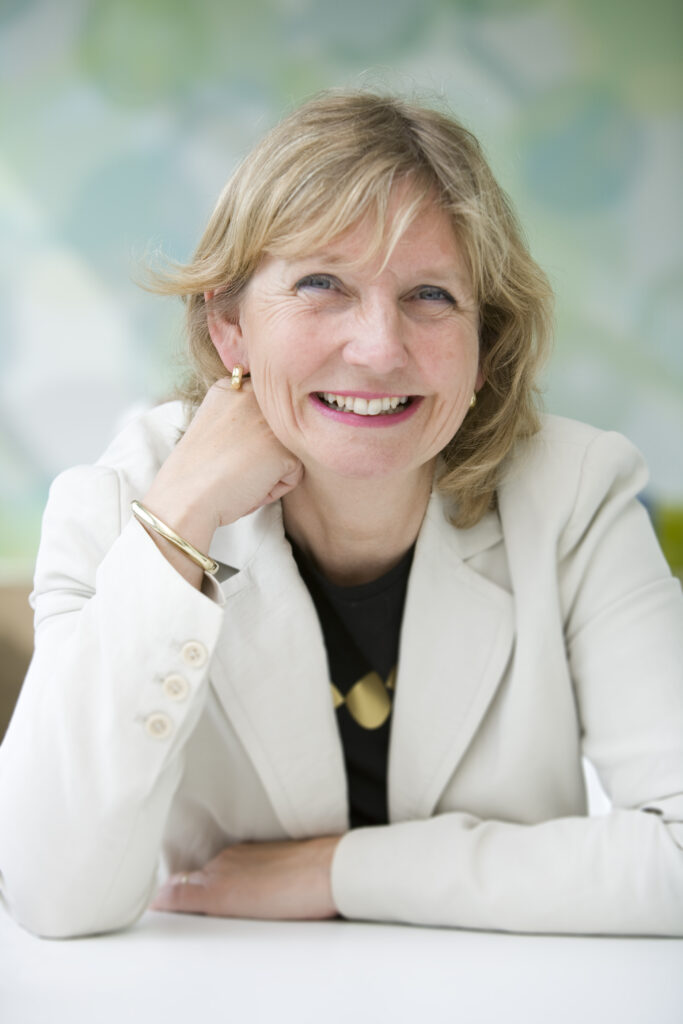
“In multidisciplinary projects, people are often experts in their own fields and basically speak different languages,” explains TU/e researcher Piet van Gool. “Most of the time, innovation goes wrong because of the human factor.”
With a background in both psychology and industrial engineering, Piet has found his perfect match in the Eindhoven Engine project Building Collaborative Capital with Tailored Developmental Journeys. This recognizes that limited focus has been placed on soft skills for effective collaboration across disciplines and institutions, which is an absolute necessity for innovation acceleration through co-location. The project will therefore develop, implement and test a set of modular and scalable instruments and interventions for assessing and developing collaborative competences.
Benefits versus burdens
The genesis for this occurred when Piet’s colleague Josette Gevers met Maarten Steinbuch to discuss soft skills within the Engine. “Most people don’t know that there are actually psychology groups in Eindhoven, but we’re in the Human Performance Management group of Industrial Engineering. At a technical university, it’s quite rare!” says Piet. “That’s also where I did my PhD, which looked at job crafting: making little changes to your job on your own initiative to become more engaged and creative in your work. I particularly looked at how people construct and use their social networks, so basically how they collaborate. It’s not so much about the technical stuff but the interactions between people and how they work.”
‘One of my goals is to give people the practical skills to create their own ideal environment.’
In terms of working methods, one complicating factor in projects can often be the combination of different institutions with different incentives. Eindhoven Engine, for example, has many PhD students who are interested in collaboration but are simply too absorbed in their own discipline. Articles must be published quickly and efficiently and shared goals may be missing, so collaboration can seem like more of a burden than a benefit.
The power of tacit knowledge
To counter this perception, the project is currently co-constructing and validating collaborative strengths-based capability profiles. “In order to unlock the collective intelligence of Eindhoven Engine, we need to assess these in our population and try to build or source interventions to improve the skills and competences of team members,” continues Piet. “Ideally, I would do this not only via questionnaires but also simulations, social network analysis and sociometric badges. I definitely want more face-to-face meetings, including with the Eindhoven Engine community. Most of the things you learn are from your peers – tacit knowledge that you can’t read anywhere. You meet in the corridor or at the coffee machine; you’re not going to have a Zoom meeting about how science works!”
Ultimately, the project should result in a toolbox of validated instruments and interventions for building collaborative capital, which can then easily be implemented on a larger scale. “One of my goals is to give people the practical skills to create their own ideal environment and make the best use of their own strengths and those of others,” Piet concludes. “If you have such an environment, innovations will come.”

In a pilot with Design Forum, the Eindhoven Engine Academy offered a ‘Making Meaning’ workshop to five of its running projects. Experienced designers, under the coordination of Jos Hardeman, have worked with the teams and their broader community towards a clearer understanding of the meaning and possible contributions of the project. The ultimate purpose is to assist the projects in developing an approach for meaningful communication about their project. The outcome is based on an outside-in analysis of how users and stakeholders see the project.
Elements of design thinking
What better than to first apply this approach to the Eindhoven Engine itself? Obviously, the approach is based on elements of design thinking, but it is not a full design thinking cycle. During a kick-off meeting with the core team, the procedure is explained and the few first ideas are exchanged. Next, the broader project team (in this case, the broader Eindhoven Engine team) can give input on their views in response to a questionnaire. Workshops are carried out with the wider project community, in which the team of designers use creative methods and aim to crystalize the essentials of the project from the viewpoint of its stakeholders. The designers analyze all of this and bring it together in a project canvas. The latter is validated in a meeting with the project team and its direct stakeholders. Eventually, a poster is created for communication purposes.
‘In fact, the Engine has a role to play in the transformation towards the co-creation paradigm of innovation.’
Lifelong learning platform
What was the outside world suggesting that Eindhoven Engine do? Other than the target groups we already have, it was suggested that we open the doors to intrapreneurs and employees interested in a sabbatical period and that we support companies and people who are having major challenges with transformation. By adding this focus, the Eindhoven Engine could become a lifelong learning platform.
Purpose-driven
The Engine is purpose-driven and accelerates the transformation from research towards application. In fact, the Engine supports application/client-driven innovations. It is important to open the projects up in order to integrate the full chain or, perhaps better, the broader network of stakeholders. Ideally, projects should include end-users, business development and students and maybe also politicians and/or the general public. This should create more flexible participation in innovation for all interested parties.
The Eindhoven Engine assists in and empowers the transformation from the power paradigm to the co-creation paradigm (Jansen and Pieters, 2017) or from the procedure-driven innovation approach to values-based innovation (Baets, 2020). This implies a stronger focus on rapid prototyping and a very close link with the researchers and companies.
In fact, the Engine has a role to play in the transformation towards the co-creation paradigm of innovation. It bridges co-creation, co-location, activation of collective intelligence, open innovation and disruption. In doing so, it facilitates innovation of wicked problems.
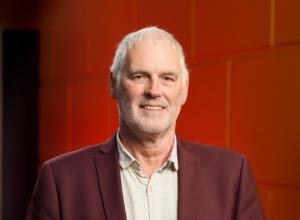
On 10 July, the third webinar of our Impactful Innovation series was held. The goal of the webinar series is to not only share challenges, innovations and impacts across Eindhoven Engine projects but also to actively work towards cross-project group interactions in order to unlock our collective intelligence.
This particular webinar was dedicated to two exciting topics. In the first presentation, Joep van der Velden (Kropman) took us into the world of continuous monitoring and fault detection of large HVAC systems (Heating, Ventilation and Air Conditioning) in order to reduce CO2 emissions. This was followed by Lukas Dekker (Catharina Ziekenhuis, TU/e), who presented the need and vision for value-based, outcome- and technology-driven future healthcare based upon innovation ecosystems.
It is very inspiring to see that these webinars are contributing to cross-organizational interactions. Big thanks to both Joep and Lukas for their excellent and enthusiastic presentations and, of course, to all participants who are enabling our collective intelligence. We look forward to the next webinar!
This particular webinar was dedicated to two exciting topics. In the first presentation, Joep van der Velden (Kropman) took us into the world of continuous monitoring and fault detection of large HVAC systems (Heating, Ventilation and Air Conditioning) in order to reduce CO2 emissions. This was followed by Lukas Dekker (Catharina Ziekenhuis, TU/e), who presented the need and vision for value-based, outcome- and technology-driven future healthcare based upon innovation ecosystems.
It is very inspiring to see that these webinars are contributing to cross-organizational interactions. Big thanks to both Joep and Lukas for their excellent and enthusiastic presentations and, of course, to all participants who are enabling our collective intelligence. We look forward to the next webinar!

In the last week of August, Eindhoven Engine and MEDICAID (e/MTIC) participated in a PDEng challenge week of TU/e.
How to measure Quality of Life?
A group of four PDEng students with different backgrounds were challenged with the question ‘How to measure Quality of Life?’ – a complex topic on which the group worked for five days.
Besides working on the problem, the students followed courses in brainstorming, design thinking, system thinking (by Walter Baets, Eindhoven Engine Academy) and teamwork.
The challenge was concluded with an excellent presentation which will serve as a basis for follow-up projects on Quality of Life. Huge thanks to Georgio Mosis for his contribution as co-case owner, to Lukas Dekker for his valuable input on this topic and to the group of PDEng students: Song, Suyash, Wan-Yi and Sukrut.


www.linkmagazine.nl
With an investment of over €2.2 million, various challenging, innovative projects with potential impacts on society and the economy are being given space within Eindhoven Engine. Together, these projects represent an investment of €16.8 million. The money for the Eindhoven Engine OpenCall comes from the Regio Deal Brainport.
Following the submission deadline of 4 June, a team of experts has examined the 11 projects submitted. Each of the projects was first assessed against formal criteria which had been published in advance and which set a high quality standard. Paul Merkus, coordinator of the OpenCall: “The text of the OpenCall 2020 was clear, which allowed the evaluation process to run smoothly and fairly. The team of experienced, independent experts was able to determine the ranking of the nine eligible proposals on the basis of these criteria. I’m proud of that.” Yesterday, the Advisory Board of Eindhoven Engine – with representatives from the knowledge institutions TU/e, TNO and Fontys and the business community – also gave a positive recommendation on the proposed selection of projects.
“We see a nice mix of diversity in the consortia.
Eindhoven Engine is picking up
more and more steam.”
“In this time of the corona pandemic in particular, we see a great need for innovation. Companies and knowledge institutions have worked together intensively to come up with strong project proposals,” add directors Katja Pahnke and Maarten Steinbuch. “We therefore see a nice mix of diversity in the consortia. Eindhoven Engine is picking up more and more steam.” The projects are highly diverse in their focus: climate, vitality, health and smart manufacturing.
“Co-creation and co-location are the basic ingredients for unlocking collective intelligence in order to give a boost to innovation: this is Eindhoven Engine’s way of working. We look forward to the participating consortia soon becoming part of our ecosystem.”

Eindhoven Engine
Eindhoven Engine unlocks the collective intelligence in the Brainport region. Thanks to a unique formula, innovators from companies can join forces with students and experienced employees from knowledge institutions in order to work together to accelerate innovation and realize disruptive co-creation projects in which co-location is a prerequisite. The founding fathers of Eindhoven Engine are the knowledge institutions Fontys, TNO and Eindhoven University of Technology and the companies Philips Healthcare, Signify, ASML, VDL, NTS and NXP. Eindhoven Engine’s funds come from the Brainport Regio Deal.
OpenCall 2020 projects
Carbyon DAC
Humanity is facing an unprecedented challenge: global warming, driven by carbon dioxide (CO2) emissions from fossil sources such as oil and gas. However, these emissions, if captured, can be a renewable carbon source with applications such as crop growth and sustainable fuel synthesis. Carbyon will develop Direct Air Capture (DAC) technology to remove CO2 from the atmosphere and turn it into a green substitute to fossil fuels. As the global demand for renewable carbon will increase once the price level reaches €50 per ton of CO2, Carbyon is challenging multidisciplinary teams within Eindhoven Engine to collaboratively improve the main cost drivers of DAC technology.
Partners: Carbyon, DIFFER, TU/e
ECoS-IAQ Efficient Comfortable School Indoor Air Quality
Installations in buildings are responsible for around 35% of all energy consumption, approximately 20% of which is due to inefficient operations. Inferior environmental conditions within classrooms can have both short- and long-term health effects, mainly due to the presence of particulate matter. With greater insights into sensors, data interpretation, trend signaling, continuous monitoring, fault detection/diagnosis and predictive maintenance, problems can be identified in the Heating Ventilation Air Conditioning (HVAC) systems of schools. The ECoS-IAQ project focuses on the creation of product development concepts for air handling manufacturers, air filter manufacturers, control companies and installers.
Partners: Building G100, Camfil, ISSO, Kropman, Lucas Onderwijs, NedAir, TU/e
SmartMan
Smart Manufacturing aims to improve factory efficiency by optimizing production processes, but SMEs often lack the capacity to create innovation in this domain. Bringing together Eindhoven Engine, Fontys, TNO and Brainport Industries Campus, the SmartMan project comprises research into various facets of smart manufacturing, including robot-assisted manufacturing, data sharing, industrial AI, virtual reality and autonomous transport. Student projects will be executed at SMEs with the goal of developing knowledge, technology and methods for combining quality, automation and flexibility in manufacturing. Success will be measured in terms of the economic value of improvements per project and company.
Partners:Fontys, TNO, Smart Industry Fieldlab Flexible Manufacturing partners, VDL, VBTI and several SMEs
iHeat@Home
The iHeat@Home project contributes to a breakthrough innovation in thermal energy storage: a heat battery which is better, cheaper, smaller and greener than any competitor. This will accelerate the energy transition, promote the development of renewable energy sources, reduce grid investments and create new business. This is all happening here in the Brainport region. iHeat@Home focuses on solutions for real-time data on the heat battery’s state-of-charge and its optimal data management, with three coherent solutions: 1. The basis for a sensor which is robust and cheap; 2. Communication protocols and data management; 3. Integration in a validated, user-ready heat battery. The aim is to bring this technology to the market by 2023.
Partners: Caldic, Fontys, TNO, TU/e, Warmtebatterij BV
POWer FITTing FITTing Persons’ vitality and optimizing their Work Environment
In an increasingly competitive global economy, physical inactivity and burnout rates are increasing. Sustainable employability based on good physical and mental health is therefore crucial, preventing absenteeism and also reducing healthcare costs. POWer FITTing optimizes the relationship between vitality and the (home) office environment through the combination of data acquisition, integration and application for the validation and acceleration of user-oriented solutions. By taking into account individual, societal and contextual factors, this enables employees to remain both healthy and productive. This benefits companies, individuals and wider society.
Partners: Fontys, HC Oranje-Rood, IMEC, TNO, TU/e
WOMBATH: towards an artificial womb
Following their birth, each child faces a physiological transition from mother-placental life support to (self-sufficient) life outside the womb. For some premature babies, this transition occurs too quickly. This places a heavy demand on the child’s immature vital organs, which is why extremely premature babies often experience serious, lifelong health problems with possible social consequences. As a trial in recent years, premature lambs have successfully been kept alive in a fluid-based environment, allowing them to develop in the same way as in the womb. The results are also promising for human application. The WOMBATH consortium will develop a medical device – an artificial womb – that supports the safe development of extremely premature babies outside of the womb. Ultimately, these infants will have better health prospects than premature infants with conventional care.
Partners: LifeTec Group, Máxima Medical Center, MEDSIM, NEMO Healthcare, POLIMI, RWTH Aachen, TU/e